
Mustering cattle: what it means, how it is done, and how to keep it low stress
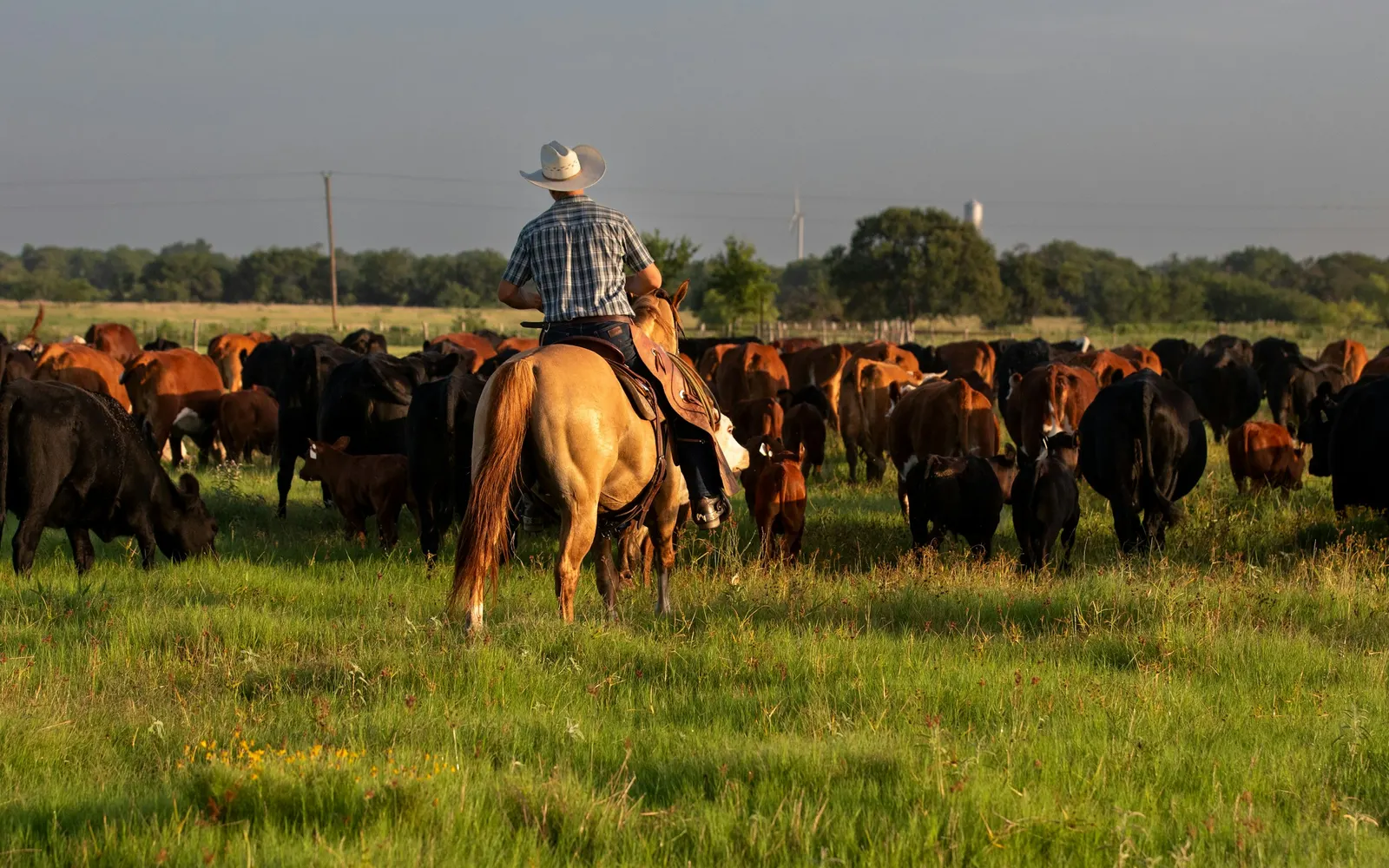
Mustering cattle means gathering them together, usually to bring a mob in from the paddock to the yards. In Australian and New Zealand English, to muster is "to gather together sheep or cows" (Oxford Learner's Dictionaries n.d.). Stations do it on horseback, on motorbikes and quad bikes, with dogs and from the air: aerial mustering uses aircraft, mostly helicopters, flying below 500 feet "to locate, direct and concentrate animals" alongside vehicles, horses and motorcycles (ATSB 2025). Whatever the method, low-stress handling works the animal's flight zone and its point of balance, which is usually at the shoulder (Grandin 2022).
What does it mean to muster cattle?
The general meaning of "muster" is to bring people together, especially soldiers. In Australian and New Zealand English there is also a farm meaning: to muster something is "to gather together sheep or cows" (Oxford Learner's Dictionaries n.d.).
The point is to get the cattle into one place so you can work with them, for example to draft (sort) them, load them or count them.
How are cattle mustered?
The method depends on the size of the country, the terrain, how quiet the cattle are, and who and what you have to hand.The Australian Transport Safety Bureau describes aerial mustering as a way "to complement traditional animal management techniques using vehicles, horses and motorcycles" (ATSB 2025).
Mustering cattle on horses
Some ranchers lead cattle rather than drive them: in one approach described by Temple Grandin, cattle are moved from the front of the herd instead of the rear, and "the herd learns to follow riders to a new pasture" (Grandin 2022).
Motorbikes, quad bikes and side-by-sides
Motorbikes, quad bikes (four-wheel all-terrain bikes) and side-by-side vehicles carry their own risk. In Queensland, wearing an approved helmet when operating a quad bike is mandatory, a requirement introduced through changes to the Work Health and Safety Regulation and Code of Practice in 2024. Workplace Health and Safety Queensland reports quad bike incidents in 2026, including fatalities, where helmets were not worn, and a rise in serious incidents in side-by-sides where seat belts, rollover protection and doors were not used (WHSQ 2026). Check the rules with your own state regulator.
Mustering with dogs
Working dogs such as the Australian Working Kelpie are used to muster stock in paddocks and to work it in yards. Research on Kelpies found that dogs working in yards and trucks handle stock "more forcefully than those mustering in larger areas (paddocks) where they can herd stock effectively from a greater distance" (Early et al. 2018). A survey of 812 owners covering 4,027 herding dogs estimated the work a typical dog does over its working life at a median value of AU$40,000, a 5.2-fold return on what it costs to keep (Arnott et al. 2014).
Mustering cattle with a helicopter
Helicopters are used to locate, direct and concentrate cattle from the air. The ATSB, citing CASA, notes that over 90 per cent of aerial mustering is done by rotary wing aircraft (helicopters), and that operators often use several helicopters on one muster where large areas need to be covered (ATSB 2025). For the research on drones, see counting cattle with drones.
What is low-stress stock handling?
Low-stress stock handling means moving animals by understanding how they see and react, instead of by noise and force. Manitoba Agriculture lists the benefits as fewer injuries to animals and handlers, calmer animals that are easier to manage, and a more productive herd (Manitoba Agriculture n.d.). Four ideas do most of the work:
- Flight zone. The animal's personal space. When you step inside it, the animal moves away (Grandin 2022). It can be as large as 90 metres (300 ft) for a range cow and 1.5 to 7.5 metres (5 to 25 ft) for a feedlot animal, and bad experiences with handlers make it bigger (Alberta Agriculture and Forestry 2004).
- Zone of awareness, or pressure zone. Just outside the flight zone. Cattle turn to face you and keep a safe distance. If all the animals are facing you, you are outside the flight zone (Grandin 2022).
- Point of balance. Usually at the shoulder. Stand behind it and the animal moves forward; stand in front of it and it backs up (Grandin 2022). In open paddocks and large pens it may sit further forward, slightly behind the eye.
- Blind spot. A cow can see nearly 90 per cent of the area around her. The only "dead spot" is directly behind her, between the hips, and walking into it is the most common handler mistake: the cow stops and turns to find you (Manitoba Agriculture n.d.).
| If you want cattle to | Do this |
|---|---|
| Move forward | Step inside the flight zone behind the point of balance |
| Speed up | Walk inside the collective flight zone in the opposite direction to the way you want them to go |
| Slow down | Walk outside the flight zone in the same direction they are travelling |
| Ease off when they move too fast | Back out of the flight zone, and reward the right movement by releasing pressure |
| Flow through a crowd pen | Fill it only half full (Manitoba suggests one-third to one-half) |
How do you move a mob calmly in the paddock?
Grandin's basic rule for groups is that moving inside the collective flight zone against the direction you want speeds the herd up, and moving outside it in the same direction slows the herd down. Alternate between the two: "Continuous pressure on the flight zone may make the herd run." Back out when the herd goes the right way, which rewards it, and apply pressure again when it slows (Grandin 2022).
Her other paddock tips are short and practical (Grandin 2022):
- Move in straight lines, in a zig-zag, and do not circle the cattle.
- Do not chase a lone animal or a few stragglers. The motion of the herd draws them back.
- Stay out of the blind spot behind the animal's rear.
- If cattle balk at a shadow or smell, wait for the leader to cross; the rest will follow.
- Be quiet. Yelling and loud, high-pitched noise is very stressful.
How do you know it worked? "Handling is high stress if animals run." You have achieved low-stress handling if the cattle start grazing soon after, and if calves quickly find their mothers (Grandin 2022). Remember the timing too: cattle can become excited in a few seconds but need 20 to 30 minutes for their heart rate to return to normal (Manitoba Agriculture n.d.).
Is helicopter mustering dangerous?
Aerial mustering is flown at low level, below 500 feet above the ground (ATSB 2025). CASA's safety risk profile for agricultural flying gives these figures for 2014 to 2023:
| Measure | Mustering | Spreading and spraying |
|---|---|---|
| Fatal accidents | 7 | 9 |
| Total accidents | 71 | 92 |
| Fatal accident rate per million hours | 4.7 | 9.8 |
| Total accident rate per million hours | 47.4 | 61.4 (see note) |
| Total flight hours over 10 years | 1,497,700 | 918,400 |
CASA notes a clear decreasing trend in the accident rate across agricultural flying over that period (CASA 2025). Midair collisions between mustering helicopters are rare, about one every 10 years for the past 20 years on ATSB data, but the risk grows as more aircraft join a muster (ATSB 2025).
Pilots must be trained for the job. To train for a mustering endorsement at a Part 137 or 138 operator, a pilot needs a low-level rating and a low-level category endorsement, plus 100 hours as pilot in command in the same aircraft category. In CASA's worked example, the trainee completes at least 20 hours of flight training and a flight test (CASA 2026). If you hire a mustering contractor, ask about their approvals; CASA is the body to check with.
Ground crew and helicopters
People on the ground are part of the risk. In June 2022, about 200 km south-west of Winton in Queensland, a mustering helicopter's tail rotor struck a station worker on a motorbike who was helping with the muster. The pilot was focused on the cattle and did not see the bike, and the two had not spoken directly by radio. The rider was seriously injured and the helicopter destroyed. Afterwards the property briefed its ground crew that the best course was "to remain under the trees or away from the helicopters area of operations until the cattle were under control. If in doubt, give way to the helicopter." The ATSB also pointed to an industry standard recommending that pilots run the daily safety brief for ground crew (ATSB 2022).
How do you count the mob after a muster?
A muster is the best chance you get to check numbers, because the whole mob is in one place. One way is to let the cattle walk steadily through a gate or race while you tally them. Use the same flight zone rules: Grandin describes moving cattle quietly out of a gate with the handler working a small triangle, so the flow can be sped up or slowed by stepping forward or back (Grandin 2022). Our guide on how to count cattle covers gate counts, tallies and photos in detail. Our Count My Herd app can also put a dot on each animal it finds in paddock photos and give a range around the count; in our first check, 9 small groups of animals (1 to 7 head, one photo each) were all counted exactly, but big mobs and sweeps of several photos have not been tested yet.
Then compare the count with your records. Texas A&M AgriLife Extension's cattle inventory guide calls cattle missing at a count "shorts in count" (not assumed dead or permanently lost) and extra cattle that turn up when animals are rounded up "longs in count", for example after a broken fence mixes mobs. It suggests tracking shorts and longs every month: if they are similar, losses are not occurring; if shorts exceed longs, there are counting errors or losses of cattle (McGrann 2019). If you are not sure what a "head" or a "mob" counts as, see what a head of cattle means.
Common questions
What does it mean to muster cattle?
To muster cattle is to gather them together, usually to bring a mob in from a paddock so you can draft, load or count them. Oxford Learner's Dictionaries marks this sense as Australian and New Zealand English: to muster is to gather together sheep or cows. Its general meaning is to bring people, especially soldiers, together.
What is helicopter mustering?
Aerial mustering uses aircraft, mostly helicopters, to locate, direct and concentrate animals. The ATSB says it is flown below 500 feet above the ground and complements mustering with vehicles, horses and motorcycles. Over 90 per cent of aerial mustering is done by helicopters, and big musters often use several at once.
Is helicopter mustering dangerous?
CASA figures for 2014 to 2023 show 71 aerial mustering accidents in Australia, 7 of them fatal, over about 1,497,700 flight hours (CASA estimated the 2023 hours). That is 47.4 accidents and 4.7 fatal accidents per million hours. CASA reports a decreasing accident trend across agricultural flying, and pilots need a specific mustering endorsement.
What is the flight zone of a cow?
The flight zone is a cow's personal space: step inside it and she moves away. Alberta's agriculture department says it can be as large as 90 metres (300 ft) for a range cow and 1.5 to 7.5 metres (5 to 25 ft) for a feedlot animal. Bad experiences with a handler make it bigger, and Temple Grandin says handlers can shrink it by spending time walking through the herd.
Where is the point of balance on a cow?
Temple Grandin puts the point of balance usually at the shoulder. Stand behind it and the animal moves forward; stand in front of it and it backs up. In open paddocks and large pens it can sit further forward, slightly behind the eye, because the cattle are free to move as a group.
How do you count cattle after mustering?
Walk the mob steadily through a gate or race and tally them, using the flight zone to control the flow. Then check the count against your records. Texas A&M AgriLife Extension calls missing cattle shorts in count and extra cattle longs in count, and suggests tracking both every month to spot losses or counting errors.
References
- Alberta Agriculture and Forestry (2004) 'Handling livestock safely', Agdex 086-4, Government of Alberta. Available at: https://www1.agriculture.alberta.ca/$department/deptdocs.nsf/all/agdex8274 (Accessed: 17 October 2026).
- Arnott, E.R., Early, J.B., Wade, C.M. and McGreevy, P.D. (2014) 'Estimating the economic value of Australian stock herding dogs', Animal Welfare, 23(2), pp. 189 to 197. Available at: https://doi.org/10.7120/09627286.23.2.189 (Accessed: 17 October 2026).
- ATSB (2022) Collision with terrain involving Robinson R22, 200 km south-west of Winton, Queensland, on 17 June 2022, Aviation Occurrence Brief AB-2022-003, Australian Transport Safety Bureau. Available at: https://www.atsb.gov.au/sites/default/files/2022-12/AB-2022-003%20FINAL.pdf (Accessed: 17 October 2026).
- ATSB (2025) Midair collision involving Robinson R22 Beta II, VH-HQH, and Robinson R22 Beta II, VH-HYQ, 51 km south-south-east of Curtin Airport, Western Australia, on 25 July 2024, Transport Safety Report AO-2024-044, Australian Transport Safety Bureau. Available at: https://www.atsb.gov.au/sites/default/files/2025-12/AO-2024-044%20-%20Final.pdf (Accessed: 17 October 2026).
- CASA (2025) 'Sector safety performance', Agricultural flying sector safety risk profile, Civil Aviation Safety Authority. Available at: https://www.casa.gov.au/operations-safety-and-travel/safety-management-systems/sector-safety-risk-profiles/agricultural-flying-sector-safety-risk-profile/sector-safety-performance (Accessed: 17 October 2026).
- CASA (2026) 'Pilots using the specialised endorsements alternative pathway', Civil Aviation Safety Authority. Available at: https://www.casa.gov.au/pilots-using-specialised-endorsements-alternative-pathway (Accessed: 17 October 2026).
- Early, J.B., Arnott, E.A., Mascord, L.J., van Rooy, D., McGreevy, P.D. and Wade, C.M. (2018) 'Work-type influences perceived livestock herding success in Australian Working Kelpies', Canine Genetics and Epidemiology, 5, article 5. Available at: https://doi.org/10.1186/s40575-018-0063-y (Accessed: 17 October 2026).
- Grandin, T. (2022) 'Understanding flight zone and point of balance for low stress handling of cattle, sheep, and pigs', Department of Animal Science, Colorado State University, updated March 2022. Available at: https://www.grandin.com/behaviour/principles/flight.zone.html (Accessed: 17 October 2026).
- Manitoba Agriculture (n.d.) 'Low stress livestock handling', Government of Manitoba. Available at: https://manitoba.ca/agriculture/livestock/beef/pubs/low-stress-livestock-handling.pdf (Accessed: 17 October 2026).
- McGrann, J. (2019) 'Monthly beef cattle inventory: head day and AUM calculator, user manual', Texas A&M AgriLife Extension, Department of Agricultural Economics. Available at: https://agecoext.tamu.edu/wp-content/uploads/2020/02/E1.User-Manual-Monthly-Beef-Cattle-Inventory-Head-Day-AMU-12-30-2019.pdf (Accessed: 17 October 2026).
- Oxford Learner's Dictionaries (n.d.) 'muster verb', Oxford University Press. Available at: https://www.oxfordlearnersdictionaries.com/definition/english/muster_1 (Accessed: 17 October 2026).
- WHSQ (2026) 'Quad bike safety', eSAFE Rural, September 2026, Workplace Health and Safety Queensland. Available at: https://www.worksafe.qld.gov.au/news-and-events/newsletters/esafe-newsletters/esafe-editions/esafe-rural/september-2026/quad-bike-safety (Accessed: 17 October 2026).