
How many cattle per acre? Sourced stocking figures for Australia, the US, Ireland, the UK and New Zealand
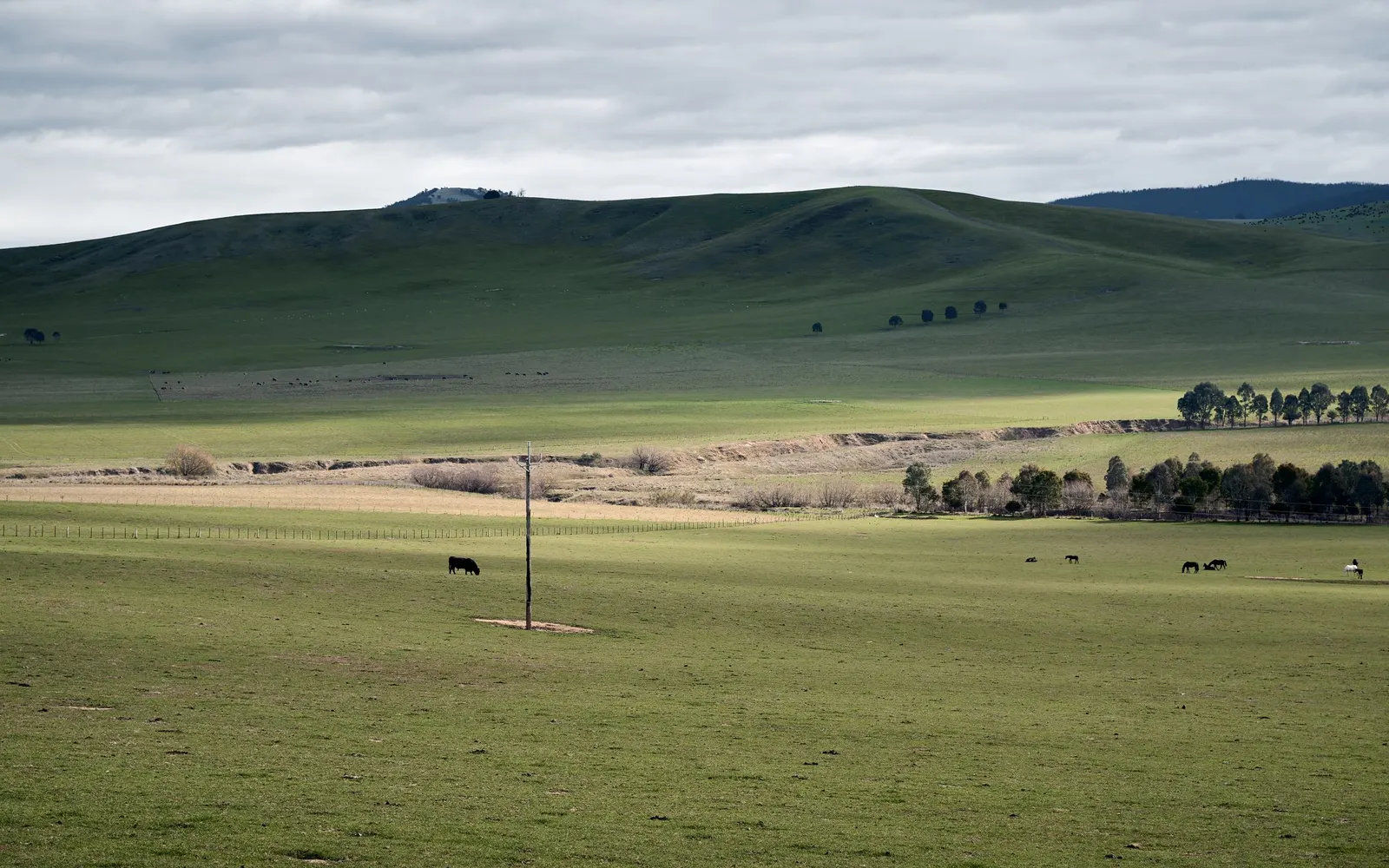
There is no single safe number of cattle per acre, because it depends on how much grass your country grows. In New South Wales, official estimates of carrying capacity run from 0.25 to 24 dry sheep equivalents (DSE) per hectare (NSW DPIRD 2022), and a 500 kg dry cow rates 8 DSE (Meat & Livestock Australia n.d.). That works out to anywhere from under 1 acre per cow on fertilised coastal pasture to about 79 acres per cow on degraded pasture near Walgett (our arithmetic). In the US, an Oklahoma rangeland example needed about 6 acres per animal unit for a year (Bidwell and Redfearn 2017).
Why is there no single answer?
Cattle eat grass, so the number of cattle an acre can feed comes down to how much grass that acre grows and how much each animal eats. Both change a lot. Rainfall, soil, fertiliser and pasture type set the supply. The size of the cows, whether they are pregnant or feeding a calf, and how long they stay in the paddock set the demand.
Meat & Livestock Australia (MLA) puts it simply: "100 cattle are not always 100 cattle." Feed that carries 100 dry cows for 90 days will only carry 100 pregnant cows for 50 days (Meat & Livestock Australia n.d.). That is why advisers count in feed units rather than heads.
Two words come up again and again. Stocking rate is how many animals you actually run on an area for a period. Carrying capacity is how many the land can support over the long run without going backwards (Bidwell and Redfearn 2017). Our guide to stocking rate, stocking density and carrying capacity explains the formulas step by step. This article sticks to the question of how many cattle per acre.
How many cattle per acre in Australia?
In southern Australia the usual feed unit is the dry sheep equivalent (DSE). In NSW, 1 DSE is the feed a 50 kg wether needs to hold its weight; other areas use a 45 kg wether (NSW DPIRD 2022). Cattle are rated in DSE too, so you can compare a paddock's carrying capacity in DSE per hectare with the DSE of your herd. Our article on the dry sheep equivalent explains the unit in more detail.
NSW DPIRD publishes long-term carrying capacity estimates for pasture types across the state. It says they are only "a basic guide for normal seasonal conditions" (NSW DPIRD 2022). The table below takes some of those ranges and divides by 8 DSE, the rating for a 500 kg dry cow or steer at maintenance (Meat & Livestock Australia n.d.).
| Region and pasture | DSE per hectare | Hectares per cow | Acres per cow |
|---|---|---|---|
| Coastal: improved pasture on good soils with fertiliser | 14 to 24 | 0.33 to 0.57 | 0.8 to 1.4 |
| Coastal: unimproved pasture | 3 to 6 | 1.3 to 2.7 | 3.3 to 6.6 |
| Southern Tablelands: sown perennial grass and legume, fertilised | 6 to 14 | 0.57 to 1.3 | 1.4 to 3.3 |
| Southern Tablelands: low quality native pasture | 0.5 to 1.5 | 5.3 to 16 | 13 to 40 |
| Northern Tablelands: natural pasture | 1.8 to 4.7 | 1.7 to 4.4 | 4.2 to 11 |
| Southern Plains: sub clover and ryegrass | 1.0 to 2.5 | 3.2 to 8 | 7.9 to 20 |
| Northern Plains: natural pasture | 0.3 to 2.0 | 4 to 27 | 9.9 to 66 |
| Degraded pasture (Walgett) | 0.25 | 32 | 79 |
NSW DPIRD adds two warnings. In drought and in the drier western country, comparing stock on a DSE basis "may be inaccurate", and the safe number of cattle may be lower than the DSE total suggests, because sheep and goats forage better than cattle when feed is short (NSW DPIRD 2022).
How many cattle per acre in Queensland and northern Australia?
Northern Australia uses a different unit, the adult equivalent (AE): a 2.25 year old, 450 kg Bos taurus steer holding its weight and walking 7 km a day. Stocking rate there is usually given as hectares per AE or AE per square kilometre (Meat & Livestock Australia 2021).
The Wambiana grazing trial near Charters Towers in Queensland ran cattle at different rates from 1997. Moderate stocking, set at the long-term carrying capacity, sat between 8 and 10 hectares per AE in most years. Heavy stocking, at twice that, ran at about 4 to 5 hectares per AE for the first eight years (O'Reagain and Bushell 2011). Moderate stocking works out to about 20 to 25 acres per AE (our arithmetic).
In the Northern Territory's Barkly region, the Creswell land type in good condition carries an average of 9 to 12 AE per square kilometre, but the loss of perennial grasses after a lack of rain "may have reduced the carrying capacity to about half that" (FutureBeef 2021). In good condition, that is about 21 to 27 acres per AE (our arithmetic).
How many cows per acre in the US and Canada?
US extension guides count in animal units (AU). One AU is a 1,000 lb cow with her calf, eating 26 lb of dry forage a day, and an animal unit month (AUM) is 780 lb of dry forage (Bidwell and Redfearn 2017). Other guides use slightly different AUM sizes, which the stocking rate formula guide covers.
- Oklahoma rangeland. An Oklahoma State worked example used ten years of clipping data from an ungrazed Loamy Prairie site in Payne County. At 25 percent harvest efficiency (the share of grass the cattle actually eat), it carried 5.88 acres per AU for a year, or 170 cows per 1,000 acres. With rotational stocking lifting harvest efficiency to 35 percent, it was 4.21 acres per AU, or 238 cows (Bidwell and Redfearn 2017).
- Oklahoma introduced pasture. A 100 acre bermudagrass pasture growing 5,000 lb of forage per acre carried 181 stocker calves of 500 lb for a 120 day season, which the authors express as 0.92 acres per AU (Bidwell and Redfearn 2017).
- Western North Dakota. On native range with a 4.5 month grazing season, a 1,000 lb cow needed 2.03 acres per month, and a herd of 50 such cows needed 456.75 acres (Ringwall 2008), about 9 acres per cow for the season (our arithmetic).
- Texas. A Texas A&M guide for small landholders says owners "usually overestimate the carrying capacity" of their land, and points them to their county Extension agent or the Natural Resources Conservation Service (NRCS), which hold forage production guides for every Texas county (Machen and Lyons 2000).
Oklahoma State also notes that cows should usually be given about 1.4 AU each, to allow for bulls and replacement heifers (Bidwell and Redfearn 2017). On the Payne County figure that is about 8.2 acres per cow in the herd (our arithmetic).
In Alberta, the provincial guide notes that most modern beef cows weigh 1,200 to 1,400 lb or more, so each counts as 1.21 to 1.4 AU rather than 1 (Alberta Agriculture and Forestry 2017).
How many cattle per acre in Ireland and the UK?
Ireland and the UK usually measure stocking in livestock units (LU) per hectare. Teagasc's National Farm Survey for 2024 reported these averages (Dillon et al. 2025):
- Cattle rearing farms, where suckler cows are the main enterprise: 1.06 LU per hectare, about 2.3 acres per LU (our arithmetic).
- Cattle other farms, where finishing cattle is the main enterprise: 1.33 LU per hectare, about 1.9 acres per LU (our arithmetic).
- Dairy farms: 2.07 LU per hectare, about 1.2 acres per LU (our arithmetic).
What counts as one LU depends on the scheme. Scotland's agri-environment guidance counts cattle over two years as 1.0 LU, cattle from six months to two years as 0.6, calves under six months as 0.4 and sheep as 0.15 (Scottish Government 2025). Check the factors your own scheme uses before comparing figures.
How many cows per hectare in New Zealand?
New Zealand sheep and beef farms count in stock units (SU). One standard used for the stock unit is a 55 kg ewe that weans one 25 kg lamb and eats 550 kg of dry matter a year. In Otago, sheep and beef farms average 4 SU per hectare, from 1.5 SU per grazing hectare on high country farms up to about 12 SU per hectare on other farm classes. Otago dairy farms average 2.9 cows per hectare (Crawford 2023), or about 1.2 cows per acre (our arithmetic).
Does cow size and a calf at foot change the number?
Yes, a lot. MLA's DSE ratings for British breed cattle show how demand climbs (Meat & Livestock Australia n.d.):
| Class of cattle | 400 kg | 500 kg |
|---|---|---|
| Dry cow or steer (maintenance) | 7 | 8 |
| Pregnant cow (last 3 months) | 9 | 11 |
| Cow with 0 to 3 month calf | 14 | 18 |
| Cow with 4 to 6 month calf | 18 | 22 |
| Cow with 7 to 10 month calf | 22 | 25 |
MLA notes these ratings apply to British breeds, and that owners of Bos indicus cattle should look for other ratings (Meat & Livestock Australia n.d.). Body weight matters as well. In North Dakota, 50 cows averaging 1,571 lb needed 641.25 acres for the season against 456.75 acres for 1,000 lb cows (Ringwall 2008), about 13 acres per cow instead of 9 (our arithmetic).
What happens if you run too many cattle per acre?
The Wambiana trial shows the cost. Heavy stocking was at first profitable in a run of wet years, but over the longer term it "generated far less profit" than the other strategies, pushed the pasture down from B to C- condition, and increased erosion. Light to moderately stocked cattle gained 30 to 50 kg more per head each year, and recovery of the heavily grazed pasture did not happen even after stocking was cut and rain returned (O'Reagain and Bushell 2011).
Seasons matter too. A University of Wyoming guide warns that carrying capacity in drought years "can be reduced by as much as 50 percent" (Stam, Scasta and Thacker 2018). A number that worked last year may be too many this year.
How do you work out how many cattle your land can carry?
- Start from local figures for your pasture type and rainfall, such as the NSW DPIRD table above, or your county NRCS or Extension office in the US (Machen and Lyons 2000).
- Rate your herd in feed units (DSE, AE, AU or LU), not heads, using its real weight and stage.
- Work it out for the hungriest time of year. NSW DPIRD says the stock you must carry in the most limiting feed period gives a guide to the maximum stocking rate (NSW DPIRD 2022).
- Keep an accurate head count, and recheck the numbers as the season changes. Our guide on how to count cattle covers the methods.
Local advisers, such as state agriculture departments, Teagasc, or your Extension office, can help you match these figures to your own paddocks.
Common questions
How many cattle per acre in Australia?
It depends on the pasture. NSW DPIRD estimates carrying capacity from 0.25 DSE per hectare on degraded pasture near Walgett to 14 to 24 DSE per hectare on fertilised coastal pasture. A 500 kg dry cow rates 8 DSE, so that is from under 1 acre to about 79 acres per cow (our arithmetic).
How many cattle per acre in Queensland?
Northern Australia counts in adult equivalents (AE), a 450 kg steer holding its weight. In the Wambiana trial near Charters Towers, moderate stocking at the long-term carrying capacity sat at 8 to 10 hectares per AE in most years, about 20 to 25 acres per AE (our arithmetic). Stocking at twice that rate damaged the pasture.
How many acres per cow in Texas or Oklahoma?
An Oklahoma State example on Payne County rangeland needed 5.88 acres per animal unit (a 1,000 lb cow and calf) for a year, or 4.21 acres with rotational stocking. A Texas A&M guide says small landholders usually overestimate carrying capacity and should ask their county Extension agent or the NRCS, which hold forage guides for every Texas county.
How many cattle per acre in the UK and Ireland?
Irish and UK figures are given in livestock units (LU) per hectare. Teagasc's 2024 National Farm Survey found cattle rearing farms averaged 1.06 LU per hectare, cattle finishing farms 1.33 and dairy farms 2.07. In Scottish scheme guidance, a cow over two years counts as 1.0 LU, so check the factors your scheme uses.
How many cows per hectare in New Zealand?
Otago dairy farms average 2.9 cows per hectare, about 1.2 cows per acre (our arithmetic). Sheep and beef farms there average 4 stock units per hectare, ranging from 1.5 on high country farms up to about 12 on other farm classes, according to an Otago Regional Council memo.
Does a cow with a calf need more land?
Yes. MLA rates a 500 kg dry cow at 8 DSE, a cow in the last 3 months of pregnancy at 11 DSE, and a cow with a 7 to 10 month old calf at 25 DSE. That is about three times the feed of a dry cow (our arithmetic), so she needs about three times the area.
References
- Alberta Agriculture and Forestry (2017) 'Using the Animal Unit Month (AUM) effectively', Agdex 420/16-1, Government of Alberta. Available at: https://www1.agriculture.alberta.ca/$department/deptdocs.nsf/all/agdex1201 (Accessed: 17 October 2026).
- Bidwell, T.G. and Redfearn, D.D. (2017) 'Stocking rate: the key to successful livestock production', PSS-2871, Oklahoma Cooperative Extension Service, Oklahoma State University. Available at: https://extension.okstate.edu/fact-sheets/stocking-rate-the-key-to-successful-livestock-production (Accessed: 17 October 2026).
- Crawford, M. (2023) 'Stocking rate definitions and threshold values', memorandum, Otago Regional Council. Available at: https://orc.govt.nz/media/nkyfhcv5/memo-stocking-rate-definitions-and-threshold-values-nov-23.pdf (Accessed: 17 October 2026).
- Dillon, E., Donnellan, T., Moran, B. and Lennon, J. (2025) Teagasc National Farm Survey 2024: final results. Athenry: Teagasc. Available at: https://teagasc.ie/wp-content/uploads/uploads/media/website/publications/2025/NFSReport2024.pdf (Accessed: 17 October 2026).
- FutureBeef (2021) 'How many cattle can the country carry?', FutureBeef. Available at: https://futurebeef.com.au/news/how-many-cattle-can-the-country-carry/ (Accessed: 17 October 2026).
- Machen, R.V. and Lyons, R.K. (2000) 'Livestock for small acreage landowners', ANSC-PU-086, Texas A&M AgriLife Extension. Available at: https://cdn-de.agrilife.org/extension/departments/ansc/ansc-pu-086/publications/files/livestock-for-small-acreage-landowners-0.pdf (Accessed: 17 October 2026).
- Meat & Livestock Australia (2021) 'NB2 glossary', Meat & Livestock Australia. Available at: https://www.mla.com.au/globalassets/mla-corporate/research-and-development/program-areas/livestock-production/nb2-glossary-june21.pdf (Accessed: 17 October 2026).
- Meat & Livestock Australia (n.d.) '4: Determine carrying capacity and stocking rate', More Beef from Pastures: Pastoral, Meat & Livestock Australia. Available at: https://mbfp-pastoral.mla.com.au/managing-your-feedbase/determine-carrying-capacity-and-stocking-rate/ (Accessed: 17 October 2026).
- National Institute of Standards and Technology (n.d.) 'NIST Guide to the SI, Appendix B.9: Factors for units listed by kind of quantity or field of science', NIST. Available at: https://www.nist.gov/pml/special-publication-811/nist-guide-si-appendix-b-conversion-factors/nist-guide-si-appendix-b9 (Accessed: 17 October 2026).
- NSW DPIRD (2022) 'Using DSEs and carrying capacities to compare sheep enterprises', Sheep gross margins April to September 2022, NSW Department of Primary Industries and Regional Development. Available at: https://www.dpird.nsw.gov.au/agriculture/budgets/livestock/sheep-gross-margins-april-september-2022/background/dse (Accessed: 17 October 2026).
- O'Reagain, P.J. and Bushell, J.J. (2011) The Wambiana grazing trial: key learnings for sustainable and profitable management in a variable environment. Agri-Science Queensland, Department of Employment, Economic Development and Innovation. Available at: https://era.dpi.qld.gov.au/id/eprint/8285/1/The-Wambiana-grazing-trial-key-learnings-November-2011.pdf (Accessed: 17 October 2026).
- Ringwall, K. (2008) 'BeefTalk: cow size, dry lot versus pasture', NDSU Extension Service, North Dakota State University. Available at: https://www.ag.ndsu.edu/dickinsonrec/archive/documents/grassland/beeftalk-articles/bt404.pdf (Accessed: 17 October 2026).
- Scottish Government (2025) 'Management diaries and advice on calculating stocking densities', Rural Payments and Services. Available at: https://www.ruralpayments.org/topics/all-schemes/agri-environment-climate-scheme/agri-environment-management-diaries/ (Accessed: 17 October 2026).
- Stam, B., Scasta, J.D. and Thacker, E. (2018) 'Animal Unit Month (AUM) concepts and applications for grazing rangelands', B-1320, University of Wyoming Extension. Available at: https://www.wyoextension.org/agpubs/pubs/B-1320_AUMs-for-web.pdf (Accessed: 17 October 2026).