
How many sheep per acre? Stocking rates in Australia, New Zealand, the UK and the US
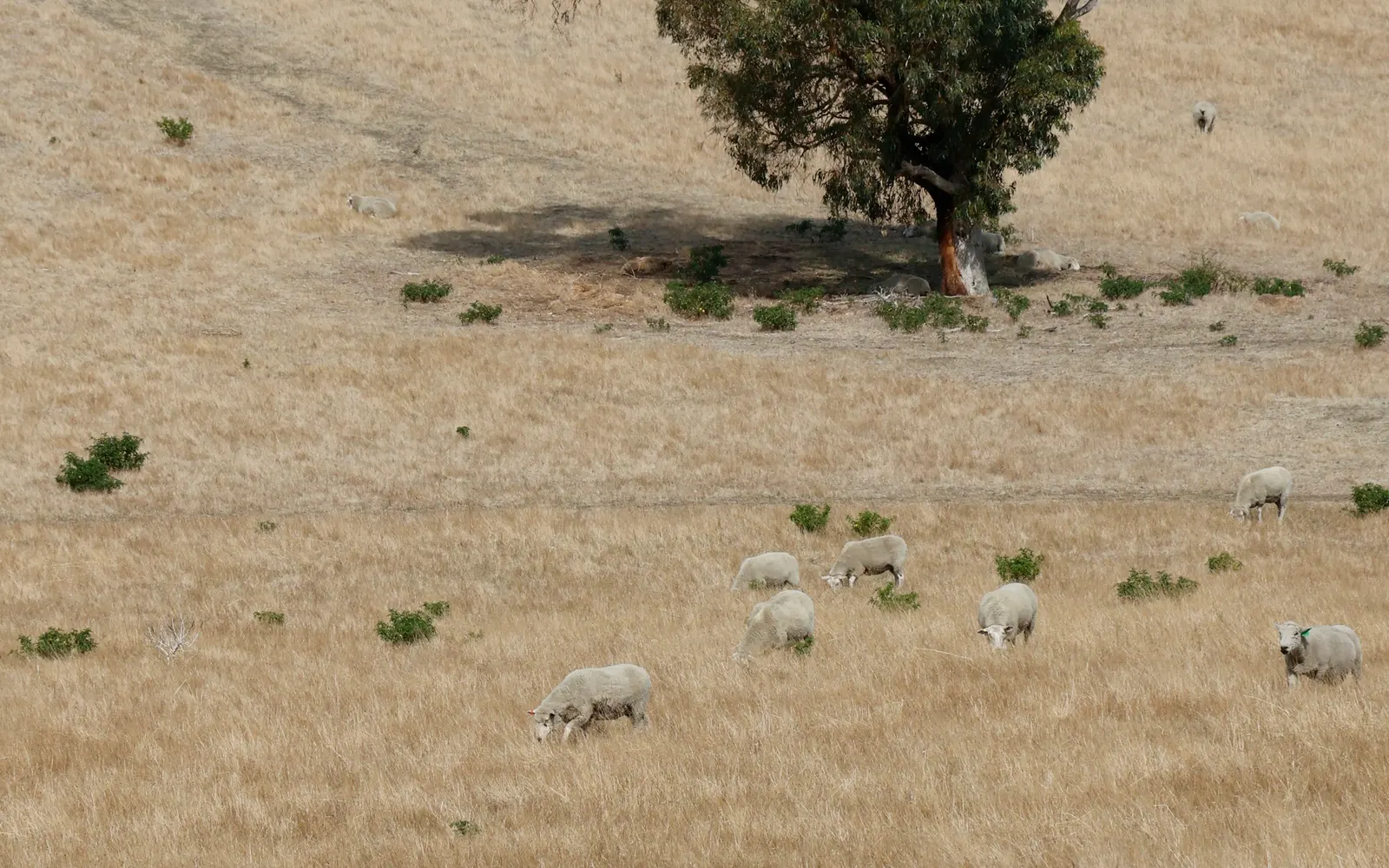
It depends on rain and pasture, but in New South Wales estimated carrying capacity runs from 0.5 to 1.5 dry sheep equivalents (DSE) per hectare on low quality Southern Tablelands native pasture up to 14 to 24 DSE per hectare on fertilised coastal pasture (NSW DPIRD 2022). One DSE is about one 50 kg dry sheep, so that is roughly 0.2 to 10 dry sheep per acre (our arithmetic). Overseas, an Irish trial stocked 10 to 14 ewes per hectare (about 4 to 6 per acre) (Creighton 2017), and Penn State Extension gives 3 mature ewes per acre as typical in New York and Michigan (Hartman 2026).
Why is there no single answer to how many sheep per acre?
A paddock carries sheep by growing grass, and grass depends on rainfall, soil, pasture species and fertiliser. NSW DPIRD's own table of long-term carrying capacities spans close to a hundredfold (our arithmetic), from 0.25 DSE per hectare on degraded pasture at Walgett to 14 to 24 DSE per hectare on fertilised coastal kikuyu, paspalum and clover (NSW DPIRD 2022). The department says the figures "can be used only as a basic guide for normal seasonal conditions".
The sheep matter too. A big ewe feeding twins eats far more than a small wether. That is why Australian advisers count feed demand in dry sheep equivalents rather than head. In NSW, 1 DSE is a 50 kg wether holding its weight, and other stock are rated by how much feed they need compared with it (NSW DPIRD 2022). A 50 kg ewe in the last six weeks of pregnancy with a single lamb rates 1.5 DSE, and with a single lamb at foot 3.0 DSE.
So when a source says "10 DSE per hectare", that is 10 dry wethers, but only about 3 ewes with lambs at foot during lactation (our arithmetic, using the 3.0 rating). Across a whole year, a 50 kg mature ewe averages about 1.5 DSE in South Australian figures (Prance 2022).
How many sheep per acre in Australia?
The table below turns published DSE per hectare figures into dry sheep per acre. We divide DSE per hectare by 2.471, because one hectare is 2.471 acres (National Institute of Standards and Technology n.d.; our arithmetic). For ewes with lambs, divide the sheep per acre figure by about 1.5 for a yearly average.
| Region and pasture | Published figure | Dry sheep per acre | Source |
|---|---|---|---|
| NSW Southern Tablelands, low quality native pasture | 0.5 to 1.5 DSE/ha | 0.2 to 0.6 | NSW DPIRD 2022 |
| NSW Southern Tablelands, sown perennial grass and legume, fertilised | 6 to 14 DSE/ha (average 9) | 2.4 to 5.7 | NSW DPIRD 2022 |
| NSW coast, improved pasture with fertiliser | 14 to 24 DSE/ha | 5.7 to 9.7 | NSW DPIRD 2022 |
| NSW Northern Plains, natural pasture | 0.3 to 2.0 DSE/ha | 0.1 to 0.8 | NSW DPIRD 2022 |
| Victoria, wool sheep farms, 2022 to 2023 averages | 10.3 to 16.2 DSE/ha | 4.2 to 6.6 | Henty 2024 |
| South Australia, Volcanic Plains and Southern Dunes (no irrigation) | 10 to more than 14 DSE/ha | 4.0 to more than 5.7 | Prance 2022 |
| Western Australia, Swan Coastal Plain small holdings, dry pasture | 2 to 10 DSE/ha | 0.8 to 4.0 | van Gool et al. 2000 |
| Queensland Mitchell grass districts | 0.8 to 1.6 ha per DSE | one sheep per 2.0 to 4.0 acres | FutureBeef n.d. |
New South Wales
NSW DPIRD's table is the most detailed public guide. The northern slopes and tablelands figures came from a survey of district agronomists; the rest are estimates (NSW DPIRD 2022). Its sheep budgets assume improved country that carries 10 DSE per hectare, which is about 4 dry sheep per acre (our arithmetic). The department also warns that in drought and in the drier western country, comparisons on a DSE basis may be inaccurate.
Victoria
Agriculture Victoria's Livestock Farm Monitor Project measures real farms. In 2022 to 2023, wool sheep enterprises averaged 12.3 DSE per hectare with winter lambing, 16.2 with spring lambing and 10.3 with autumn lambing; prime lamb enterprises averaged 9.3 to 15.0 (Henty 2024). Autumn enterprises "tended to be in locations where average annual rainfall and carrying capacity were lower". That puts typical Victorian sheep country at about 4 to 6.6 dry sheep per acre (our arithmetic).
South Australia
In the Volcanic Plains and Southern Dunes around Mount Gambier, where rainfall is 700 to 750 mm, sustainable figures range from 10 DSE per hectare on shallow soils over limestone to more than 14 DSE per hectare on well drained volcanic loams (Prance 2022). These assume no irrigation. The same guide says a DSE needs roughly 1 kg of pasture dry matter a day.
Western Australia
For small rural holdings on the Swan Coastal Plain and Darling Scarp, the state's guideline sets base rates from 2 DSE per hectare on rapidly drained sands to 10 DSE per hectare on loamy flats and gravel slopes, and 10 to 25 DSE per hectare on irrigated pasture (van Gool et al. 2000). It warns these "do not necessarily apply to broadacre commercial grazing enterprises". In the rangelands, sheep normally graze within 3 km of a watering point, so country further out carries less (DPIRD WA 2025).
Queensland
In Queensland's Mitchell grass country, sheep numbers are often written as hectares per DSE. Locally recommended rates are 1.6 ha per DSE at Julia Creek, 1.4 at Longreach, 1.2 at Blackall and Surat, 1.0 at Hodgson and 0.8 at Muckadilla (FutureBeef n.d.). At Toorak Research Station near Julia Creek, the short-term carrying capacity needed to stay at a safe 22% use of pasture swung from 0.2 to 2.5 DSE per hectare with the season (Phelps 2012).
How many sheep per acre in New Zealand?
New Zealand counts stock units (SU) instead of DSE. A base ewe used in the system weighs 55 kg, weans one lamb and eats about 550 kg of dry matter a year (Crawford 2023), so one SU is roughly one ewe and her lamb. Beef + Lamb New Zealand's farm survey describes each farm class by its usual stocking rate (Beef + Lamb New Zealand 2026):
- South Island high country: typically up to 3 SU per hectare (up to about 1.2 per acre, our arithmetic).
- South Island hill country: 2 to 7 SU per hectare (about 0.8 to 2.8 per acre).
- North Island hard hill country: mostly 6 to 10 SU per hectare (about 2.4 to 4.0 per acre).
- North Island hill country: mostly 7 to 13 SU per hectare (about 2.8 to 5.3 per acre).
- North Island finishing farms: mostly 8 to 15 SU per hectare (about 3.2 to 6.1 per acre).
- South Island finishing farms: about 9 to 14 SU per hectare (about 3.6 to 5.7 per acre).
These are whole-farm figures that include beef cattle, so they show what the land carries, not sheep alone.
How many sheep per acre in the UK and Ireland?
At Teagasc in Ireland, a five-year study ran rotationally grazed flocks at 10, 12 and 14 ewes per hectare, which is about 4.0, 4.9 and 5.7 ewes per acre (Creighton 2017; our arithmetic). Lamb output per hectare rose with stocking rate, but lifetime lamb growth was lower at the high rate, and the authors saw "potential limitations to increasing SR above 12 ewes per hectare". They found it takes about 860 kg of grass dry matter to feed a ewe and her lambs for a year.
In the UK, AHDB's grazing manual works in livestock units (LU), where 1 LU is the feed energy a mature black and white dairy cow needs for maintenance. It calls 1 to 1.5 LU per hectare a low stocking rate and 2 to 2.5 LU per hectare a high one, and rates a lowland ewe at 0.11 LU, an upland ewe at 0.08 and a hill ewe at 0.06 (AHDB 2018). On lowland ewes alone, the low band works out at about 9 to 14 ewes per hectare, or 3.7 to 5.5 per acre (our arithmetic).
How many sheep per acre in the US?
US figures usually come in animal units (AU), based on a 1,000 lb cow. Oregon State University Extension counts five large sheep or seven smaller sheep as one AU, and rates a mature sheep at 0.20 AU, eating about 5.2 lb of forage a day (Filley 2018).
For the eastern states, Penn State Extension says experience in New York and Michigan puts a typical stocking rate for mature ewes at 3 ewes per acre (Hartman 2026). Another Penn State guide says about 10 acres of fair to good pasture should supply 80 to 90 percent of the needs of 30 to 35 ewes (Barkley et al. 2021). We found no extension figures for Texas or other drier western states that we could verify, so check with your state extension service.
Does rotational grazing let you run more sheep per acre?
Rotation changes how many sheep are in one paddock at a time, which is stocking density, not stocking rate. South Australian advice notes that good managers use carefully watched high grazing pressure of 100 or more DSE per hectare for short periods of 2 to 10 days, to manage weeds and surplus pasture (Prance 2022). The long-term carrying capacity of the farm is a separate number.
Rotation can help you grow and use more grass, and that is what lifts carrying capacity. The Irish study raised ewe numbers only alongside more grass, and advised that "increasing stocking rate must always be in conjunction with increased grass production" (Creighton 2017).
How do you work out sheep per acre for your own paddock?
- Find a carrying capacity for your district and pasture in DSE per hectare, from the tables above or your state agency.
- Measure the grazed area, leaving out bush, dams and country too far from water.
- Multiply the area by DSE per hectare to get total DSE the paddock can carry.
- Divide by the DSE rating of your sheep, for example 1.0 for 50 kg dry wethers or about 1.5 for 50 kg ewes over a year (NSW DPIRD 2022; Prance 2022).
A Queensland guide gives a feed-based check. One DSE eats about 400 kg of dry matter a year. If a paddock has 1,300 kg per hectare of dry matter in March and you plan to use only 30%, that is about 400 kg, "enough for one sheep per hectare" (FutureBeef n.d.). Plan for the hungriest time of year: NSW DPIRD suggests working out monthly needs, because stock carried in the most limiting feed period set the maximum stocking rate (NSW DPIRD 2022).
If you run cattle as well, convert them into DSE first. Our guide to how many cattle per acre has the cattle ratings.
What happens if you put too many sheep on an acre?
Too many sheep eat out the best grasses, leave bare ground and need more hand feeding. A Queensland Mitchell grass guide says stocking too heavily "weakens the valuable species, encourages annual grasses and broad-leaved weeds, exposes the soil surface to erosion" (FutureBeef n.d.). In 25 years of sheep grazing at Toorak, a moderate rate using about 22% of pasture each year held land condition, while heavier use of about 35 to 45% led to patches of degraded land after 20 years (Phelps 2012). Western Australian guidance lists wind and water erosion, tree decline and nutrients in groundwater and waterways among the damage that stocking above sustainable rates can cause (van Gool et al. 2000).
Common questions
How many sheep can you have per acre in Australia?
It ranges widely. NSW DPIRD estimates run from 0.5 to 1.5 DSE per hectare on low quality Southern Tablelands native pasture to 14 to 24 DSE per hectare on fertilised coastal pasture, which is about 0.2 to 10 dry sheep per acre by our arithmetic. Victorian wool sheep farms averaged 10.3 to 16.2 DSE per hectare in 2022 to 2023.
How many sheep per hectare?
In DSE terms, from about 0.3 per hectare on NSW Northern Plains natural pasture to 14 to 24 on fertilised NSW coastal pasture. An Irish trial ran 10 to 14 ewes per hectare and found lifetime lamb growth suffered above 12. Count ewes with lambs as more than one DSE each, about 1.5 over a year.
How many sheep per acre in the UK?
AHDB calls 1 to 1.5 livestock units per hectare a low stocking rate and rates a lowland ewe at 0.11 livestock units. On lowland ewes alone that is about 9 to 14 ewes per hectare, or 3.7 to 5.5 ewes per acre, by our arithmetic. Upland and hill ewes are rated lower, at 0.08 and 0.06.
How many sheep per acre in New Zealand?
Beef + Lamb New Zealand describes farm classes by stock units per hectare: up to 3 on South Island high country, 2 to 7 on South Island hill country, 6 to 10 on North Island hard hill country and 8 to 15 on North Island finishing farms. One stock unit is roughly a ewe rearing one lamb.
How many sheep for 1 acre?
Penn State Extension says experience in New York and Michigan puts a typical stocking rate for mature ewes at 3 ewes per acre. In Australia, good improved pasture at 10 DSE per hectare carries about 4 dry sheep per acre by our arithmetic, but native pasture in drier country may need several acres per sheep.
References
- AHDB (2018) Planning grazing strategies for Better Returns, Better Returns Programme Manual 8. Kenilworth: Agriculture and Horticulture Development Board. Available at: https://media.ahdb.org.uk/media/Default/Imported%20Publication%20Docs/Planning-grazing-strategies-for-better-returns.pdf (Accessed: 17 October 2026).
- Barkley, M.E., Hartman, D.W., Kime, L.F. and Harper, J.K. (2021) 'Spring lamb production', Penn State Extension. Available at: https://extension.psu.edu/spring-lamb-production (Accessed: 17 October 2026).
- Beef + Lamb New Zealand (2026) Sheep and Beef Farm Survey insights: Northland, quintile analysis of final 2024-25 survey data. Wellington: Beef + Lamb New Zealand. Available at: https://beeflambnz.com/sites/default/files/2026-08/2025%20NLD.pdf (Accessed: 17 October 2026).
- Crawford, M. (2023) Stocking rate definitions and threshold values, memorandum, 20 November. Dunedin: Otago Regional Council. Available at: https://orc.govt.nz/media/nkyfhcv5/memo-stocking-rate-definitions-and-threshold-values-nov-23.pdf (Accessed: 17 October 2026).
- Creighton, P. (2017) The effects of stocking rate and ewe prolificacy potential on the efficiency of lamb production and grass utilization in pasture based systems, Technology Update, project 6168. Teagasc. Available at: https://teagasc.ie/wp-content/uploads/media/website/publications/2018/6168_TechnologyUpdate_PhilipCreighton_StockingRate_and_Prolificacy.pdf (Accessed: 17 October 2026).
- DPIRD WA (2025) 'Carrying capacity: definitions for the Western Australian Rangelands', Department of Primary Industries and Regional Development, Western Australia. Available at: https://www.dpird.wa.gov.au/siteassets/documents/soil/carrying-capacity-definititions-rangelands-wa.pdf (Accessed: 17 October 2026).
- Filley, S. (2018) How to determine pasture rental rates, EM 9665, reviewed 2024. Oregon State University Extension Service. Available at: https://extension.oregonstate.edu/catalog/em-9665-how-determine-pasture-rental-rates (Accessed: 17 October 2026).
- FutureBeef (n.d.) 'Stocking rate has the over-riding effect on pasture stability and animal production', Mitchell grass management guide extract. Available at: https://futurebeef.com.au/wp-content/uploads/MG_3a-stocking.pdf (Accessed: 17 October 2026).
- Hartman, D. (2026) 'Sheep grazing to maintain solar energy sites in Pennsylvania', Penn State Extension, updated 13 April 2026. Available at: https://extension.psu.edu/sheep-grazing-to-maintain-solar-energy-sites-in-pennsylvania (Accessed: 17 October 2026).
- Henty, S. (2024) 'Comparing enterprise performance based on lambing season', Sheep Notes newsletter, Autumn 2024, Agriculture Victoria. Available at: https://agriculture.vic.gov.au/support-and-resources/newsletters/sheep-notes-newsletter/autumn-2024/comparing-enterprise-performance-based-on-lambing-season (Accessed: 17 October 2026).
- National Institute of Standards and Technology (n.d.) 'NIST Guide to the SI, Appendix B.9: Factors for units listed by kind of quantity or field of science', NIST. Available at: https://www.nist.gov/pml/special-publication-811/nist-guide-si-appendix-b-conversion-factors/nist-guide-si-appendix-b9 (Accessed: 17 October 2026).
- NSW DPIRD (2022) 'Using DSEs and carrying capacities to compare sheep enterprises', Sheep gross margins April to September 2022, NSW Department of Primary Industries and Regional Development. Available at: https://www.dpird.nsw.gov.au/agriculture/budgets/livestock/sheep-gross-margins-april-september-2022/background/dse (Accessed: 17 October 2026).
- Phelps, D. (2012) Best-bet practices for managing the Mitchell grasslands of Queensland. Longreach: Department of Employment, Economic Development and Innovation, Queensland. Available at: https://futurebeef.com.au/wp-content/uploads/2017/08/Best-bet-grazing-management-Mitchell-grasslands-2012.pdf (Accessed: 17 October 2026).
- Prance, T. (2022) Sustainable land use for red meat and wool production in the Volcanic Plains and Southern Dunes sub-region (Limestone Coast, SA). Limestone Coast Landscape Board. Available at: https://cdn.environment.sa.gov.au/landscape/images/202301-Sustainable-Land-Use-Guide_-Volcanic-Plains-and-Southern-Dunes_MFMG_Jan-2023.pdf (Accessed: 17 October 2026).
- van Gool, D., Angell, K. and Stephens, L. (2000) Stocking rate guidelines for rural small holdings, Swan Coastal Plain and Darling Scarp and surrounds, Western Australia, Miscellaneous publication 2/00. Perth: Agriculture Western Australia. Available at: https://library.dpird.wa.gov.au/misc_pbns/3/ (Accessed: 17 October 2026).