
Dry sheep equivalent (DSE): what it means, DSE tables and how to calculate it
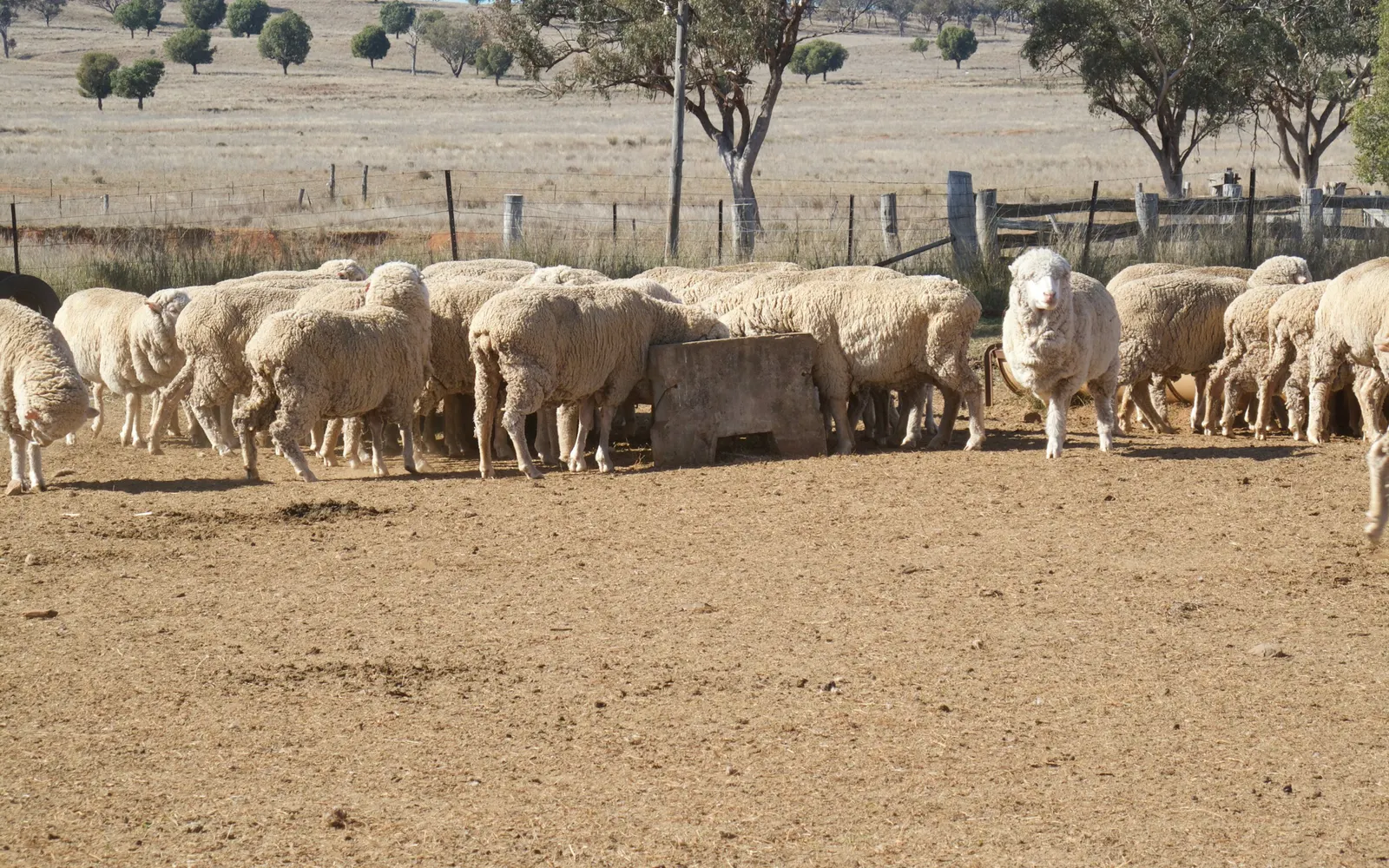
A dry sheep equivalent (DSE) is a unit of feed demand: in New South Wales, 1 DSE is the feed a 50 kg wether needs to hold its weight, and other areas use a 45 kg wether (NSW DPIRD 2022). Every other animal is rated against it, so a 50 kg ewe with a single lamb at foot is 3.0 DSE (NSW DPIRD 2022) and a 500 kg dry British breed cow is 8 DSE (Meat & Livestock Australia n.d.). Add up the DSE of your stock, divide by the hectares they graze, and you have your stocking rate in DSE per hectare.
What is a dry sheep equivalent?
Animals eat different amounts. A big cow feeding a calf needs far more grass than a small wether. A DSE puts them all on one scale, so you can compare a mob of cattle, a flock of ewes and a few horses by how much feed they need, not how many head they are.
Agriculture Victoria defines the DSE as "the standard unit used to compare the metabolisable energy (ME) requirements of different classes of stock for feed budgeting purposes" (Agriculture Victoria 2025). Metabolisable energy is the part of the feed's energy an animal can actually use after losses in dung, urine and gas (DPIRD WA 2026).
The standard animal is not quite the same everywhere:
- NSW: a 50 kg wether maintained at constant weight is 1 DSE (NSW DPIRD 2022). Meat & Livestock Australia quotes the NSW definition as a 50 kg Merino wether, dry ewe or non-pregnant ewe maintaining its condition (Meat & Livestock Australia n.d.).
- South Australia: the energy to maintain a 50 kg wether or dry ewe in condition score 2.5, which is 8.5 MJ of ME a day (Prance 2022).
- Western Australia: the state's animal equivalent guide uses a 45 kg Merino wether with zero weight gain (DPIRD WA 2026).
Pick one system and stick with it. Meat & Livestock Australia advises deciding on the model that best fits your stock and "always use that model, rather than switching between different ratings" (Meat & Livestock Australia n.d.).
How much does one DSE eat?
South Australian guidance says a DSE needs approximately 1 kg of pasture dry matter a day (Prance 2022). A Queensland Mitchell grass guide estimates one DSE eats 400 kg of dry matter a year (FutureBeef n.d.). Dry matter is the weight of feed with the water taken out.
DSE table for sheep
Sheep ratings rise with body weight, growth, pregnancy and, most of all, feeding lambs.
| Class of sheep | Lighter | Heavier |
|---|---|---|
| Weaned lamb gaining 100 g/day | 0.8 DSE at 15 kg | 1.1 DSE at 25 kg |
| Weaned lamb gaining 200 g/day | 1.3 DSE at 15 kg | 1.7 DSE at 25 kg |
| Dry ewe or wether, holding weight | 0.9 DSE at 45 kg | 1.0 DSE at 50 kg |
| Dry ewe or wether gaining 50 g/day | 1.2 DSE at 45 kg | 1.3 DSE at 50 kg |
| Dry ewe or wether gaining 100 g/day | 1.5 DSE at 45 kg | 1.6 DSE at 50 kg |
| Pregnant ewe, last 6 weeks, single | 1.4 DSE at 45 kg | 1.5 DSE at 50 kg |
| Pregnant ewe, last 6 weeks, twins | 1.8 DSE at 45 kg | 1.9 DSE at 50 kg |
| Ewe with single lamb at foot | 2.4 DSE at 45 kg | 3.0 DSE at 50 kg |
| Ewe with twin lambs at foot | 2.8 DSE at 45 kg | 3.2 DSE at 50 kg |
For whole-year planning, South Australian figures give a yearly average of 1.5 DSE for a 50 kg mature ewe, 1.8 for a 60 kg ewe and 2 for a 70 kg ewe (Prance 2022). Bigger sheep cost more feed: a 70 kg wether at maintenance rates 1.4 DSE.
In Western Australia's small holdings guide, a 75 kg ram is 1.5 DSE and a 40 to 45 kg lambing ewe with her lamb is also 1.5 (van Gool et al. 2000).
Dry sheep equivalent for cattle
Cattle are where DSE does most of its work, because one cow can equal 7 to 25 sheep depending on her size and stage.
| Class of cattle | Lighter | Heavier |
|---|---|---|
| Weaned calf gaining 0.25 kg/day | 5.5 DSE at 200 kg | 6.5 DSE at 250 kg |
| Weaned calf gaining 0.75 kg/day | 8.0 DSE at 200 kg | 9.0 DSE at 250 kg |
| Yearling gaining 0.25 kg/day | 7 DSE at 400 kg | 8 DSE at 500 kg |
| Yearling gaining 0.75 kg/day | 10 DSE at 400 kg | 11 DSE at 500 kg |
| Dry cow or steer, maintenance | 7 DSE at 400 kg | 8 DSE at 500 kg |
| Pregnant cow, last 3 months | 9 DSE at 400 kg | 11 DSE at 500 kg |
| Cow with 0 to 3 month calf | 14 DSE at 400 kg | 18 DSE at 500 kg |
| Cow with 4 to 6 month calf | 18 DSE at 400 kg | 22 DSE at 500 kg |
| Cow with 7 to 10 month calf | 22 DSE at 400 kg | 25 DSE at 500 kg |
So "how many sheep equal a cow?" has no single answer. A 500 kg dry cow is about 8 sheep, but the same cow with a big calf at foot is about 25 (Meat & Livestock Australia n.d.). That is why MLA warns "100 cattle are not always 100 cattle": feed that carries 100 dry cows for 90 days carries 100 pregnant cows for only 50 days. For working these ratings into paddock numbers, see how many cattle per acre.
DSE for horses, goats, alpacas, deer and kangaroos
Western Australia's small holdings guide rates a 450 kg light horse at 10 DSE, a 1,000 kg draught horse at 20 and a 250 kg pony at 5. A dry Angora goat of 30 to 35 kg is 0.7 DSE, a 60 to 70 kg alpaca 0.8, and a 120 kg red deer 2.2 (van Gool et al. 2000).
Wildlife eats too. South Australia's Department for Environment and Water reports that an average 25 kg kangaroo is equivalent to 0.35 DSE, measured against a 45 kg sheep, so its 5 million kangaroos in the commercial harvest zone equalled about 1.75 million sheep (DEW 2018).
How do you calculate dry sheep equivalents?
- Split your stock into classes, such as dry ewes, ewes with lambs, weaners, cows with calves and steers.
- Give each class a DSE rating from one table, matched to weight and stage.
- Multiply head in each class by its rating, then add the classes together for total DSE.
- Divide total DSE by grazing hectares for your stocking rate in DSE per hectare.
A South Australian fact sheet gives the last step as a worked example: 365.5 DSE on 40 hectares is a stocking rate of 9.0 DSE per hectare (SA Murray-Darling Basin NRM Board n.d.).
Here is a simple example of our own using the NSW sheep table: 400 ewes of 50 kg with single lambs at foot (3.0 DSE each) is 1,200 DSE, plus 100 dry 50 kg wethers (1.0 each) is 100 DSE, giving 1,300 DSE (our arithmetic). On 200 hectares, that is 6.5 DSE per hectare. Compare that with the carrying capacity for your district, covered in how many sheep per acre.
Add time: DSE days
Feed runs out over time, so MLA's pastoral guide uses DSE days per hectare. In its example, a paddock holds 86,100 DSE days of feed, but 100 cows rated 7 DSE while dry and 9 DSE when pregnant need 106,700 DSE days over 135 days. The 20,600 DSE day gap means about 152 DSE too many, so 21 cows should come out (Meat & Livestock Australia n.d.). NSW DPIRD likewise suggests working out DSE month by month, because the tightest feed period sets the safe maximum (NSW DPIRD 2022).
DSE vs AE: what is the difference?
An adult equivalent (AE) is the cattle version, used mostly in northern Australia. The standard AE is a 2.25 year old, 450 kg Bos taurus steer with zero weight gain, walking 7 km a day, which needs 73 MJ of ME a day (DPIRD WA 2026). With a 45 kg wether as the DSE, Western Australia counts 8.4 DSE in one AE.
Conversions vary by source, so check which one a figure uses:
- DPIRD WA: 1 AE equals 8.4 DSE (DPIRD WA 2026).
- Queensland Mitchell grass guide: 1 AE is "usually reckoned to be equal to 7 (in the north) or 8 (in the south) dse" (FutureBeef n.d.).
- Queensland best-bet guide: a DSE is 0.11 of an AE (Phelps 2012).
Use AE where your district's carrying capacities are written in hectares per AE, and DSE where they are in DSE per hectare. Mixing them is how stocking rates go wrong. Our article on stocking rate vs stocking density explains how these numbers fit together.
Similar units in other countries
- New Zealand stock unit (SU): a base ewe of 55 kg weaning one lamb and eating 550 kg of dry matter a year (Crawford 2023).
- UK livestock unit (LU): the feed to maintain a mature black and white dairy cow; a lowland ewe is 0.11 LU (AHDB 2018).
- US animal unit (AU): a 1,000 lb cow with or without a calf; a mature sheep is 0.20 AU (Filley 2018).
Is a DSE rating exact?
No. NSW DPIRD says its ratings rest on assumptions about weights, growth rates and lambing percentages, and vary from farm to farm (NSW DPIRD 2022). It also warns that in drought and in drier western country, sheep and goats forage better than cattle when feed is short, so the safe number of cattle may be lower than the DSE totals suggest.
Ratings also depend on whether they measure what an animal needs or what it actually eats. A 60 kg ewe with one lamb needs 21 MJ a day, which is 2.5 DSE; on rich pasture she may eat 28 MJ, which is 3.3 DSE (Prance 2022). A Western Australian study likewise found that stocking rates worked out from estimated energy intake differed from traditional fixed ratings, most at higher feed levels (Hyder 2006).
MLA also notes the calculations are averages of energy needs that ignore paddock slope, pasture type and protein or mineral needs, and says this is where your own knowledge of the paddock and stock has to be built into the grazing plan (Meat & Livestock Australia n.d.).
Common questions
What is a dry sheep equivalent?
A dry sheep equivalent (DSE) is a standard unit of feed demand. In NSW, 1 DSE is the feed a 50 kg wether needs to hold its weight; some areas use a 45 kg wether. Other stock are rated against it, so a 50 kg ewe with a single lamb at foot is 3.0 DSE.
How many DSE is a cow?
For British breed cattle, a dry cow at maintenance is 7 DSE at 400 kg and 8 DSE at 500 kg. A cow in the last 3 months of pregnancy is 9 to 11 DSE, and a cow with a calf is 14 to 25 DSE, rising with the calf's age and the cow's weight.
How many sheep are equivalent to a cow?
It depends on the cow. A 500 kg dry cow at maintenance rates 8 DSE, so about 8 dry 50 kg sheep. The same cow with a 7 to 10 month calf rates 25 DSE. That is why Meat and Livestock Australia warns that 100 cattle are not always 100 cattle.
How do you calculate dry sheep equivalent?
Split stock into classes, give each class a DSE rating from one table, multiply head by rating and add them up. Divide total DSE by the grazing hectares to get DSE per hectare. For example, 365.5 DSE on 40 hectares is a stocking rate of 9.0 DSE per hectare.
What is the DSE of a kangaroo?
South Australia's Department for Environment and Water reports that an average 25 kg kangaroo is equivalent to 0.35 DSE, measured against a 45 kg sheep. On that basis, it put the 5 million kangaroos in the state's commercial harvest zone at about 1.75 million sheep equivalents.
What is the difference between DSE and AE?
DSE is based on a wether; AE, used mostly in northern Australia, is based on a 2.25 year old, 450 kg steer walking 7 km a day. Western Australia counts 8.4 DSE in one AE. A Queensland guide uses 7 in the north or 8 in the south.
References
- Agriculture Victoria (2025) Livestock Farm Monitor Project: Victoria annual report 2024-25. Melbourne: Department of Energy, Environment and Climate Action. Available at: https://agriculture.vic.gov.au/__data/assets/pdf_file/0019/1171414/Livestock-Farm-Monitor-Annual-Report-202425-website.pdf (Accessed: 17 October 2026).
- AHDB (2018) Planning grazing strategies for Better Returns, Better Returns Programme Manual 8. Kenilworth: Agriculture and Horticulture Development Board. Available at: https://media.ahdb.org.uk/media/Default/Imported%20Publication%20Docs/Planning-grazing-strategies-for-better-returns.pdf (Accessed: 17 October 2026).
- Crawford, M. (2023) Stocking rate definitions and threshold values, memorandum, 20 November. Dunedin: Otago Regional Council. Available at: https://orc.govt.nz/media/nkyfhcv5/memo-stocking-rate-definitions-and-threshold-values-nov-23.pdf (Accessed: 17 October 2026).
- DEW (2018) State of evidence: kangaroos and their management in South Australia, DEW Technical report 2018/11. Adelaide: Department for Environment and Water, Government of South Australia. Available at: https://data.environment.sa.gov.au/Content/Publications/State%20of%20evidence%20-%20Kangaroos%20and%20their%20management%20in%20South%20Australia.pdf (Accessed: 17 October 2026).
- DPIRD WA (2026) 'What are Animal Equivalents?', Department of Primary Industries and Regional Development, Western Australia. Available at: https://www.dpird.wa.gov.au/siteassets/documents/soil/what-are-animal-equivalents.pdf (Accessed: 17 October 2026).
- Filley, S. (2018) How to determine pasture rental rates, EM 9665, reviewed 2024. Oregon State University Extension Service. Available at: https://extension.oregonstate.edu/catalog/em-9665-how-determine-pasture-rental-rates (Accessed: 17 October 2026).
- FutureBeef (n.d.) 'Stocking rate has the over-riding effect on pasture stability and animal production', Mitchell grass management guide extract. Available at: https://futurebeef.com.au/wp-content/uploads/MG_3a-stocking.pdf (Accessed: 17 October 2026).
- Hyder, M.W. (2006) 'Calculation of dry sheep equivalents', Australian Society of Animal Production 26th Biennial Conference, short communication. Lifetime Wool Project, Department of Agriculture Western Australia. Available at: https://www.wool.com/globalassets/wool/other/lifetime-wool/research-papers/calculation-of-dry-sheep-equivalents.pdf (Accessed: 17 October 2026).
- Meat & Livestock Australia (n.d.) '4: Determine carrying capacity and stocking rate', More Beef from Pastures: Pastoral, Meat & Livestock Australia. Available at: https://mbfp-pastoral.mla.com.au/managing-your-feedbase/determine-carrying-capacity-and-stocking-rate/ (Accessed: 17 October 2026).
- NSW DPIRD (2022) 'Using DSEs and carrying capacities to compare sheep enterprises', Sheep gross margins April to September 2022, NSW Department of Primary Industries and Regional Development. Available at: https://www.dpird.nsw.gov.au/agriculture/budgets/livestock/sheep-gross-margins-april-september-2022/background/dse (Accessed: 17 October 2026).
- Phelps, D. (2012) Best-bet practices for managing the Mitchell grasslands of Queensland. Longreach: Department of Employment, Economic Development and Innovation, Queensland. Available at: https://futurebeef.com.au/wp-content/uploads/2017/08/Best-bet-grazing-management-Mitchell-grasslands-2012.pdf (Accessed: 17 October 2026).
- Prance, T. (2022) Sustainable land use for red meat and wool production in the Volcanic Plains and Southern Dunes sub-region (Limestone Coast, SA). Limestone Coast Landscape Board. Available at: https://cdn.environment.sa.gov.au/landscape/images/202301-Sustainable-Land-Use-Guide_-Volcanic-Plains-and-Southern-Dunes_MFMG_Jan-2023.pdf (Accessed: 17 October 2026).
- SA Murray-Darling Basin NRM Board (n.d.) Grazing livestock in the Mount Lofty Ranges, fact sheet. Murray Bridge: SA Murray-Darling Basin Natural Resources Management Board. Available at: https://data.environment.sa.gov.au/Content/Publications/grazing_livestock.pdf (Accessed: 17 October 2026).
- van Gool, D., Angell, K. and Stephens, L. (2000) Stocking rate guidelines for rural small holdings, Swan Coastal Plain and Darling Scarp and surrounds, Western Australia, Miscellaneous publication 2/00. Perth: Agriculture Western Australia. Available at: https://library.dpird.wa.gov.au/misc_pbns/3/ (Accessed: 17 October 2026).