
How many horses per acre? Land per horse in Australia, the UK and the US
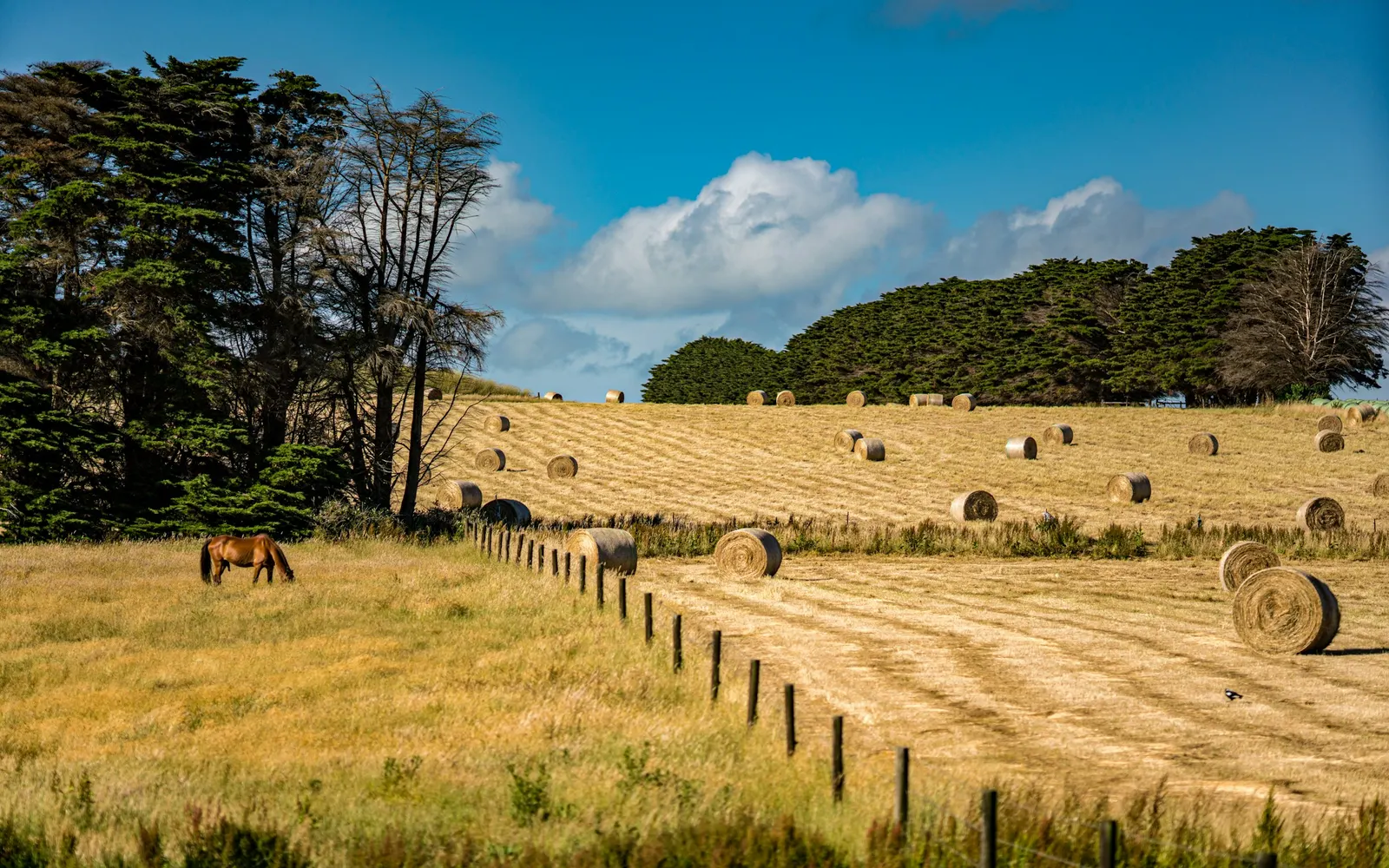
Most official guides land at about 1.25 to 2.5 acres per horse on good, well managed pasture, and much more on dry country. The UK government's code of practice says each horse needs about 0.5 to 1.0 hectares (1.25 to 2.5 acres) of good grazing if it gets no extra feed (Defra 2017). US extension uses a rule of thumb of 1.5 to 2 acres of intensively managed land per horse, and up to 30 to 38 acres on dry, unirrigated pasture (eXtension Horses 2019). In Western Australia a light horse counts as 10 dry sheep equivalents, so on pasture rated 6 to 10 DSE per hectare it needs about 1 to 1.7 hectares (2.5 to 4.1 acres), and up to 5 hectares on poor sands (our arithmetic from van Gool et al. 2000).
Why do horses need so much land?
A horse is big, eats a lot and moves a lot. Agriculture Victoria's guide is 1 to 2 kg of roughage (pasture, hay or chaff) per 100 kg of bodyweight each day. That works out to 3 to 7 kg a day for a pony, 7 to 10 kg for a galloway, 10 to 13 kg for a 500 to 650 kg horse, and more than 13 kg for a heavy horse (Agriculture Victoria 2026). Queensland's small-property guide puts the accepted figure at about three per cent of bodyweight, mostly forage (Department of Agriculture and Fisheries 2022).
In US terms, Oklahoma State rates a horse at 1.25 animal units, eating about 32 lb of dry forage a day against 26 lb for a 1,000 lb cow (Bidwell and Redfearn 2017). The University of Georgia gives a range of 1.25 to 2.00 for a mature horse (Morgan et al. 2024). So one horse usually needs more land than one cow.
Horses are also hard on the ground. Western Australia's guidelines note that horses are "much more active than cattle" and that trampling may reduce stocking rates slightly (van Gool et al. 2000). The UK code warns about poaching, where wet ground is broken into muddy patches by hooves (Defra 2017).
How many horses per acre in Australia?
We found no single national figure for Australia. The most detailed government numbers we found come from Western Australia, and they use dry sheep equivalents. The guide uses a 50 kg wether as its standard: a stocking rate of so many DSE per hectare is the number of adult wethers each hectare can carry all year round (van Gool et al. 2000). The guide rates horses like this:
- 450 kg light horse: 10 DSE
- 1,000 kg draught horse: 20 DSE
- 250 kg pony: 5 DSE
The same guidelines, written for rainfed pasture on the Swan Coastal Plain and Darling Scarp where rain is above 650 mm a year, set recommended dry stocking rates of 2 to 10 DSE per hectare depending on soil, and 10 to 25 DSE per hectare on irrigated pasture (van Gool et al. 2000). Dividing a light horse's 10 DSE by those dry rates gives 1 hectare (2.5 acres) per horse on the best land, about 1.7 hectares (4.1 acres) on 6 DSE land, and 5 hectares (12.4 acres) on the poorest sands (our arithmetic). The guide also turns this into horses per lot.
| Land type | 1 ha dry | 2 ha dry | 5 ha dry | 1 ha irrigated |
|---|---|---|---|---|
| Loamy flats, loamy slopes, gravel slopes | 1 horse | 2 horses | 5 horses | 2 horses |
| Well drained yellow to brown sands, clay flats | No horse | 1 horse | 3 horses | 2 horses |
| Rapidly drained pale sands | No horse | No horse | 1 horse | 1 horse |
One hectare is 2.471 acres, so 2 hectares is about 4.9 acres and 5 hectares about 12.4 acres (our arithmetic from NIST n.d.). The guide adds that because a light horse is 10 DSE, "the only way to keep horses on many small holdings is by using special management", which would normally need a stock management plan and council permission (van Gool et al. 2000). The department's current page says most local planning schemes require stocking rates in special rural and rural residential zones to match the department's recommendations (DPIRD WA n.d.).
Victoria
Agriculture Victoria does not give a hectares-per-horse number on its basic horse care page. It sets out what a horse needs: enough roughage to stay in good body condition, extra feed if there is not enough pasture, clean water (as a guide, 25 to 45 litres a day in hot weather), shelter, and space to walk and run. It also warns that too much green pasture is a common cause of laminitis, a very painful hoof condition, especially in ponies, and that horses are herd animals that need the company of other horses (Agriculture Victoria 2026). So a paddock that is too lush can be a problem as well as one that is too bare.
Queensland
Queensland's Department of Agriculture and Fisheries guide to livestock on small properties does not give a hectares-per-horse figure either. It defines long-term carrying capacity as the average number of animals a grazing area can support over a set period such as 10 or more years, and stocking rate as the number of stock per unit area at a particular time (Department of Agriculture and Fisheries 2022). It also says horse owners must be a registered biosecurity entity (RBE) with horses recorded on their property identification code (PIC), and that horse movements need a movement record (Department of Agriculture and Fisheries 2022). Check the current rules with Biosecurity Queensland.
How many horses per acre in the UK?
The Defra code of practice for horses, ponies and donkeys says the area needed "will depend on the type of grass, ground conditions, time of year, type of horse and degree of pasture management". As a general rule, each horse needs about 0.5 to 1.0 hectares (1.25 to 2.5 acres) of grazing of suitable quality if no supplementary feeding is provided, and each donkey at least 0.2 to 0.4 hectares (half an acre to one acre). A smaller area may be enough where a horse is mainly housed and only turned out now and then (Defra 2017).
Is it UK law?
Not directly. The code was presented to Parliament under the Animal Welfare Act 2006. Breaking a provision of the code "is not an offence in itself", but if a welfare case comes to court, the court will look at whether the code was followed (Defra 2017). For your own situation, read the code itself or ask a vet or your local authority.
How many horses per acre in the US?
eXtension, the US cooperative extension network, notes that there "has been little research done on the space requirements of horses". Its rule of thumb is 1.5 to 2 acres of open, intensively managed land per horse, with these regional figures (eXtension Horses 2019):
- Eastern regions, properly managed pasture: 2 acres per horse.
- Southern, Midwest and Western regions, properly managed pasture that is irrigated in some places (most places in the West): 2 to 10 acres per horse.
- Non-irrigated dryland pasture: up to 30 to 38 acres per horse.
- Minimum turnout area for exercise, where the horse is fed hay: one tenth of an acre, about 4,500 square feet.
The same page says to check state and county rules, since different states have different minimum land requirements for livestock (eXtension Horses 2019). That is why searches like "how many horses per acre by state" have no single answer.
Texas
For the Texas agricultural valuation, Gregg Appraisal District, for example, publishes its own standards and states that horses kept for personal or family use do not qualify for agriculture production (Gregg Appraisal District 2025). Ask your own county appraisal district for its rules.
Horses vs cows, sheep and goats per acre
Using one unit makes mixed paddocks easier to plan. In Western Australia's table, a 450 kg light horse is 10 DSE, a 425 kg dry cow 8 DSE and a dry Angora goat 0.7 DSE. The guide's own example: on a property with 22 DSE you could run 22 sheep, 2 light horses, one draught horse or 31 dry Angora goats, or any mix (van Gool et al. 2000). So one light horse uses about the same feed as 1.25 dry cows or 14 dry Angora goats (our arithmetic). If you are weighing up goats instead, our guide to how many goats per acre uses the same units, and how many cattle per acre covers cows. For the unit itself, see our dry sheep equivalent guide.
How can you keep horses on less land?
Official guides agree that management, not just area, decides how many horses a paddock can carry:
- Manage the pasture. Defra recommends a pasture management programme: picking up droppings, rotating grazing areas and, where possible, taking horses off very wet ground to prevent poaching (Defra 2017). Agriculture Victoria adds that removing manure reduces worm contamination of pastures (Agriculture Victoria 2026).
- Feed hay. Both Defra and eXtension say a smaller area can work when the horse is housed or fed and the land is used mainly for exercise (Defra 2017; eXtension Horses 2019).
- Irrigate. In the WA table, 1 hectare of irrigated pasture on well drained yellow to brown sands carries 2 horses, where 1 hectare of dry pasture on the same land carries none (van Gool et al. 2000).
- Rotate. The University of Georgia notes that with rotational stocking, rest periods and better use of forage should let the stocking rate rise over time, but only if animals move on when the feed runs out (Morgan et al. 2024). Our guide to stocking rate vs stocking density explains how rotation changes density without changing the overall rate.
Keep an eye on condition too. Agriculture Victoria says a horse is too thin if its ribs show and too fat if it has a round rump, big belly and crested neck, and that body condition must not fall below score 2 (Agriculture Victoria 2026).
Common questions
How many acres do you need for one horse?
On good, well managed pasture with no extra feed, the UK Defra code says about 0.5 to 1.0 hectares (1.25 to 2.5 acres) per horse. US extension uses 1.5 to 2 acres of intensively managed land, but 2 to 10 acres in the South, Midwest and West, and up to 30 to 38 acres on dry, unirrigated pasture.
How many horses per acre in Australia?
We found no national figure. Western Australia rates a 450 kg light horse at 10 dry sheep equivalents and recommends 2 to 10 DSE per hectare on dry small-holding pasture, so one light horse needs about 1 to 5 hectares (2.5 to 12.4 acres) depending on soil (our arithmetic). Councils may set their own rules.
How many horses per acre is UK law?
We found no law that sets a number. The Defra code of practice gives a general rule of about 0.5 to 1.0 hectares (1.25 to 2.5 acres) per horse with no supplementary feed. Breaking the code is not an offence in itself, but a court hearing a welfare case will look at whether the code was followed.
Can you keep a horse on one acre?
Only with extra feed and good management in most cases. In Western Australia's guidelines, 1 hectare (about 2.5 acres) of dry pasture carries one horse only on the best soils, and none on sandy soils. US extension says a horse fed hay needs at least one tenth of an acre for turnout.
How many sheep equal one horse?
Western Australia rates a 450 kg light horse at 10 dry sheep equivalents, a 250 kg pony at 5 and a 1,000 kg draught horse at 20. Its example says 22 DSE could carry 22 sheep, 2 light horses, one draught horse or 31 dry Angora goats.
References
- Agriculture Victoria (2026) 'Basic horse care', Agriculture Victoria. Available at: https://agriculture.vic.gov.au/livestock-and-animals/horses/basic-horse-care (Accessed: 17 October 2026).
- Bidwell, T.G. and Redfearn, D.D. (2017) 'Stocking rate: the key to successful livestock production', Fact Sheet PSS-2871, Oklahoma State University Extension. Available at: https://extension.okstate.edu/fact-sheets/stocking-rate-the-key-to-successful-livestock-production.html (Accessed: 17 October 2026).
- Defra (2017) Code of practice for the welfare of horses, ponies, donkeys and their hybrids. London: Department for Environment, Food and Rural Affairs. Available at: https://assets.publishing.service.gov.uk/media/5ad4b5f5e5274a76c13dfb33/horses-welfare-codes-of-practice-april2018.pdf (Accessed: 17 October 2026).
- Department of Agriculture and Fisheries (2022) A guide to managing livestock on small properties. Brisbane: State of Queensland. Available at: https://www.publications.qld.gov.au/dataset/b8599d1b-d819-4197-acf3-2731590536a6/resource/3be17400-4acb-412b-898d-88a859785e6f/download/guide-managing-livestock-small-properties-2022.pdf (Accessed: 17 October 2026).
- DPIRD WA (n.d.) 'Stocking rate guidelines for rural small holdings', Department of Primary Industries and Regional Development, Western Australia. Available at: https://www.dpird.wa.gov.au/businesses/livestock-farming/stocking-rate-guidelines-for-rural-small-holdings/ (Accessed: 17 October 2026).
- eXtension Horses (2019) 'How much land do I need for a horse?', eXtension Foundation. Available at: https://horses.extension.org/how-much-land-do-i-need-for-a-horse/ (Accessed: 17 October 2026).
- Gregg Appraisal District (2025) 'Standards and intensity schedules for qualifying productive property valuation 2025'. Available at: https://greggtx.wordpress.gsacorp.io/wp-content/uploads/sites/24/2025/09/STANDARDS-FOR-PRODUCTIVE-LAND-VALUATION.2025.pdf (Accessed: 17 October 2026).
- Morgan, S., Tucker, J.J., Baxter, L. and Burt, J. (2024) 'Understanding stocking rate in pasture systems', Bulletin 1568, University of Georgia Cooperative Extension. Available at: https://fieldreport.caes.uga.edu/publications/B1568/understanding-stocking-rate-in-pasture-systems/ (Accessed: 17 October 2026).
- National Institute of Standards and Technology (n.d.) 'NIST Guide to the SI, Appendix B.9: Factors for units listed by kind of quantity or field of science', NIST. Available at: https://www.nist.gov/pml/special-publication-811/nist-guide-si-appendix-b-conversion-factors/nist-guide-si-appendix-b9 (Accessed: 17 October 2026).
- van Gool, D., Angell, K. and Stephens, L. (2000) 'Stocking rate guidelines for rural small holdings, Swan Coastal Plain and Darling Scarp and surrounds, Western Australia', Miscellaneous publication 2/00, Agriculture Western Australia, Perth. Available at: https://library.dpird.wa.gov.au/misc_pbns/3/ (Accessed: 17 October 2026).