
How to count cattle: through a gate, in the paddock and from the air
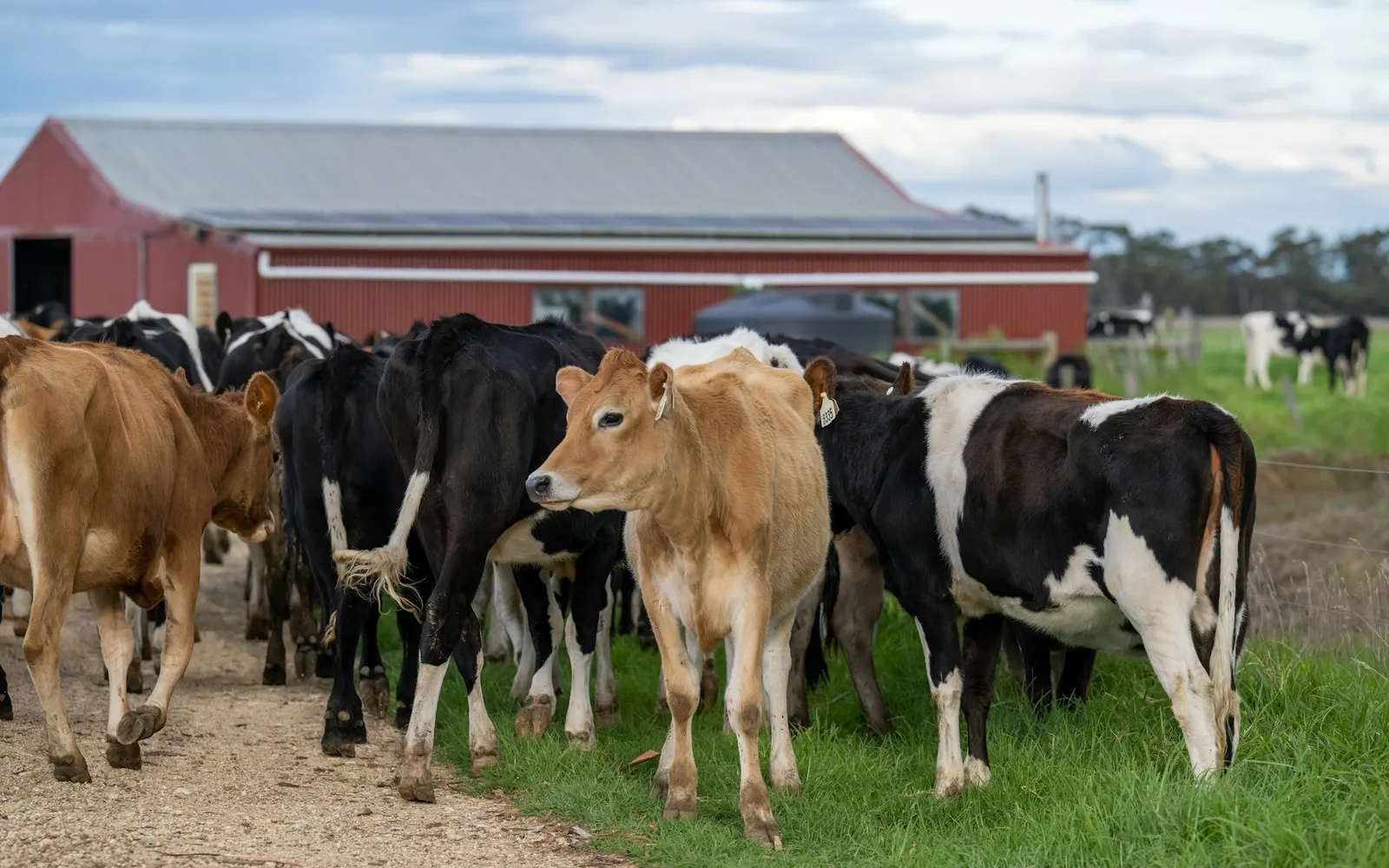
The surest way to count cattle is one animal at a time as they walk single file through a gate, alley or race. Extension guidance on yard design says a round or funnel shaped crowding pen lines cattle up to move single file, and a curved, solid sided alley keeps them flowing because each animal sees only the one in front (Karisch 2025). Counting a loose mob by eye is much harder: in lab studies, people take in fewer than 4 items at a glance quickly and accurately, but counting more than 4 is slow, effortful and error-prone (Trick and Pylyshyn 1994). Drone photos help in open paddocks, but moving cattle get counted twice (Shao et al. 2019).
Why does an accurate cattle count matter?
A head count is the first check on whether anything has gone wrong. Researchers building a drone counting system put it simply: "Frequently checking the number of cattle in a grazing area is necessary work in grazing cattle management", because farmers compare the count with the number of cattle they should have (Shao et al. 2019).
It is also harder than it sounds. A Penn State Extension educator filming a daily morning check on a Pennsylvania beef farm says the main focus "is to get an accurate head count. This is harder than you might think", and that the job is to watch each animal, not just the herd (Stiles-Mikesell n.d.).
Counts also feed the paperwork. In Australia, a PIC reconciliation is "a stocktake of all NLIS devices on a property": it shows any gap between the electronic tags physically on the place and the tags registered to that property identification code (PIC) on the National Livestock Identification System database (Integrity Systems Company 2022). In New Zealand, when a meat processor checks an animal status declaration, "Cattle tallies must match exactly", while sheep tallies may be out by 3% either way (OSPRI n.d.).
How do you count cattle through a gate or race?
The idea is to turn a mob into a line. Mississippi State University Extension describes the layout most yards use (Karisch 2025):
- Crowding pen. A lane leads to a crowding pen (also called a sweep tub) "where cattle line up to move single-file through an alley". A quarter or half circle, or a funnel, is the recommended shape.
- Sweep gate. A gate swings around behind the cattle to guide them single file into the working alley.
- Curved, solid sided alley. Cattle "see only the animal directly in front of them and naturally follow", and solid sides stop movement outside from making them balk (stop and refuse to go on).
- Length and width. The working alley should be at least 20 feet (about 6.1 m, our arithmetic using conversion factors from National Institute of Standards and Technology n.d.) long, wide enough to move forward but not to turn around. A good width for calves is 18 inches (about 46 cm, our arithmetic).
- Backstops. Hinged bars keep cattle from backing up the alley. That also helps whoever is counting, since an animal that backs out and walks through again would be counted twice.
- Catwalk. A walkway along the outside lets handlers stand above the cattle, keep them flowing and "read ear tags in advance".
Not every yard drafts through a race. In New Zealand, "often cattle are drafted in open yards rather than through drafting gates", with handlers using staffs to separate the animals they want into another pen (Peden 2009).
Should you count in ones, twos or fives?
Counting in small groups is a stock agent's trick. At New Zealand sales, sheep "are counted as they run through a gateway or along a race. Some agents count them by the pair as they run past; others count five at a time" (Stringleman 2009). The same idea works for cattle that come through a gate side by side.
The psychology fits. Seeing how many items there are without counting, called subitizing, works for "fewer than 4 items" and is "rapid (40-100 ms/item), effortless, and accurate". Counting more than 4 is "slow (250-350 ms/item), effortful, and error-prone" (Trick and Pylyshyn 1994). Those were lab tests, not cattle yards, but they suggest why calling cattle in ones, twos or threes beats trying to take in a whole bunch at once. For more on group counting, see how to count sheep, where the method is used every day.
How do you count cattle in a paddock?
A paddock count is the hardest kind, because cattle hide behind each other, behind trees and over rises. Even professional aerial surveys allow for this. A survey of buffalo, cattle, horses and donkeys across the Top End of the Northern Territory improved its accuracy "by applying habitat-specific visibility correction factors to animals counted in groups" (Bayliss and Yeomans 1989). In plain words, the counters knew they missed some animals in thick country and corrected for it.
That is why the race methods above are the benchmark: a gateway shows you every animal, and a paddock does not.
Photo counting is a newer option. Count My Herd, our phone app, counts cattle in a few paddock photos, puts a dot on every animal it found and gives a range around the count. It is early days: in our first check, 9 small groups of animals (1 to 7 head, one photo each) were all counted exactly, and big mobs and sweeps of several photos have not been tested yet. Treat it as an estimate, not a count through the race.
Can you count cattle from photos or a drone?
Yes, with limits. In a controlled test with life sized replica seabird colonies containing a known number of fake birds, counts made from drone images were "on average, between 43% and 96% more accurate than the traditional ground-based data collection method", and those counts could be semi-automated with a high degree of accuracy (Hodgson et al. 2018). Those were model birds, not cattle, but the lesson about a high view carries over.
For cattle, a University of Tokyo team flew a drone at around 50 m (about 164 feet, our arithmetic) over pastures of 1.5 to 5 hectares (about 3.7 to 12.4 acres, our arithmetic) and used software to find each animal (Shao et al. 2019). The detector scored a precision of 0.957 and a recall of 0.946, meaning few false finds and few misses on that test set. To stop the same animal being counted in overlapping photos, the team built a 3D model of the paddock from the images. When every animal moved less than its own body length during the flight, the count was out by up to 3 and there were no double counts. When cattle moved, some counts came out about 1.5 times the true value. In one flight over 12 cattle the system logged 13 double counts (Shao et al. 2019).
Our articles on counting cattle with drones and AI livestock counting go further into the research and the rules.
| Method | What helps | What goes wrong |
|---|---|---|
| Through a race or alley | Crowding pen, single file, curved solid sided alley at least 20 ft long (Karisch 2025) | Cattle backing up the alley; backstops prevent it (Karisch 2025) |
| Through a gate in open yards | Handlers with staffs guide the cattle they want away from the mob into a separate pen (Peden 2009) | Not covered by our sources |
| By eye in the paddock | Small groups: fewer than 4 items are seen accurately at a glance (Trick and Pylyshyn 1994) | Larger numbers are error-prone; animals hidden by country (Bayliss and Yeomans 1989) |
| Drone photos with software | Within 3 of the true count when cattle stood still (Shao et al. 2019) | Moving cattle double counted; grass mistaken for cattle (Shao et al. 2019) |
| NLIS PIC reconciliation (Australia) | Compares devices on the property with the database, once a year (Integrity Systems Company 2022) | Not covered by our sources |
Why do cattle counts go wrong?
- Animals move. The biggest errors in the drone trial came from cattle that walked from one part of the paddock to another between photos, so the software saw them twice (Shao et al. 2019). People counting a milling mob have the same problem.
- Too many at once. Past about 4 items, counting is "slow" and "error-prone" (Trick and Pylyshyn 1994). A Meat & Livestock Australia report on live export noted "the lack of 100% accuracy inherent in human counting of large numbers of animals that superficially look alike" (Kassler 2001).
- Animals touching or overlapping. The same report explains that machines built to count people rely on the gap between heads, but sheep in a crowd touch, and one may be partly on top of another (Kassler 2001).
- Hidden animals. Visibility depends on the country, which is why aerial surveys correct their counts by habitat (Bayliss and Yeomans 1989). Hilly ground also made it hard to stitch drone photos, so an animal "may appear twice in the stitched image or may disappear" (Shao et al. 2019).
- Things that are not cattle. In the drone trial, three detections in one image "are actually grass as the background", which added three animals that did not exist (Shao et al. 2019).
How do you check that a cattle count is right?
Professionals count more than once. At New Zealand stock sales, sheep "might be counted three or four times" between arriving at a sale and being trucked out (Stringleman 2009).
Then check the count against a record. In Australia, compare your tag count with the NLIS database through a PIC reconciliation (Integrity Systems Company 2022); our guide to cattle ear tags and NLIS explains the tags themselves. Any rules on how often you must count or report depend on where you farm, so check with your state or national livestock identification body.
Common questions
How do you count cattle accurately?
Count them one at a time as they pass single file. Extension guidance says a round or funnel shaped crowding pen lines cattle up to move single file into a curved, solid sided alley at least 20 feet long, where each animal sees only the one in front and follows. Backstops stop cattle backing up, which also prevents counting one animal twice.
Why is it hard to count a mob of cattle by eye?
People can take in fewer than 4 items at a glance quickly and accurately. Counting more than 4 is slow, at 250 to 350 milliseconds per item in lab tests, and error-prone. Cattle also move, overlap and hide behind trees or rises, so a loose mob in a paddock is much harder to count than a line through a gate.
Can a drone count cattle?
Drone photos can help. In one study, software counting cattle from drone images was within 3 of the true number when the cattle stood still, with no double counts. When cattle moved during the flight, some counts came out about 1.5 times the real number, because the same animals appeared in different photos.
How often should you count cattle?
It depends on the job. One Penn State Extension example shows a beef farmer getting a head count on a daily morning check during calving. In Australia, producers are encouraged to do a PIC reconciliation once a year, comparing the NLIS devices on the property with the database. Check your own state or national body for any rules.
What is a PIC reconciliation?
It is a stocktake of all NLIS devices on an Australian property. It shows any difference between the number of electronic tags physically on the property and the number registered to that property identification code on the National Livestock Identification System database. Integrity Systems Company encourages producers to do one once a year.
References
- Bayliss, P. and Yeomans, K.M. (1989) 'Distribution and abundance of feral livestock in the Top End of the Northern Territory (1985-86), and their relation to population control', Wildlife Research, 16(6), pp. 651 to 676. Available at: https://doi.org/10.1071/WR9890651 (Accessed: 17 October 2026).
- Hodgson, J.C., Mott, R., Baylis, S.M., Pham, T.T., Wotherspoon, S., Kilpatrick, A.D., Raja Segaran, R., Reid, I., Terauds, A. and Koh, L.P. (2018) 'Drones count wildlife more accurately and precisely than humans', Methods in Ecology and Evolution, 9(5), pp. 1160 to 1167. Available at: https://doi.org/10.1111/2041-210X.12974 (Accessed: 17 October 2026).
- Integrity Systems Company (2022) 'How to do a PIC reconciliation', webinar, 8 September 2022. Available at: https://www.integritysystems.com.au/about/news--events/events/2022/how-to-do-a-pic-reconciliation (Accessed: 17 October 2026).
- Karisch, B.B. (2025) Beef cattle handling facilities, Publication 2787, Mississippi State University Extension Service. Available at: https://extension.msstate.edu/sites/default/files/document/2025-08/P2787_web.pdf (Accessed: 17 October 2026).
- Kassler, M. (2001) Automatic counting of sheep, Final report LIVE.106, Meat & Livestock Australia and LiveCorp. Available at: https://www.mla.com.au/contentassets/4312471af05f4f2ebd74484c901dd5df/live.106_final_report.pdf (Accessed: 17 October 2026).
- National Institute of Standards and Technology (n.d.) 'NIST Guide to the SI, Appendix B.9: Factors for units listed by kind of quantity or field of science', NIST. Available at: https://www.nist.gov/pml/special-publication-811/nist-guide-si-appendix-b-conversion-factors/nist-guide-si-appendix-b9 (Accessed: 17 October 2026).
- OSPRI (n.d.) 'How to find and complete a meat processing animal status declaration (ASD) in MyOSPRI', OSPRI New Zealand. Available at: https://ospri.co.nz/farming-industry-providers/myospri-user-guides-for-farming-industry-providers/how-to-find-and-complete-a-meat-processing-animal-status-declaration-asd-in-myospri (Accessed: 17 October 2026).
- Peden, R. (2009) 'Farm fencing: Yards', Te Ara, the Encyclopedia of New Zealand. Available at: https://teara.govt.nz/en/farm-fencing/page-6 (Accessed: 17 October 2026).
- Shao, W., Kawakami, R., Yoshihashi, R., You, S., Kawase, H. and Naemura, T. (2019) 'Cattle detection and counting in UAV images based on convolutional neural networks', International Journal of Remote Sensing, 41(1), pp. 31 to 52. Available at: https://doi.org/10.1080/01431161.2019.1624858 (Accessed: 17 October 2026).
- Stiles-Mikesell, C. (n.d.) 'Agriculture Working For You: Keeping Track of the Beef Herd', video, Penn State Extension. Available at: https://extension.psu.edu/agriculture-working-for-you-keeping-track-of-the-beef-herd (Accessed: 17 October 2026).
- Stringleman, H. (2009) 'Stock and station agencies: Role in the community', Te Ara, the Encyclopedia of New Zealand. Available at: https://teara.govt.nz/mi/photograph/17397/counting-sheep (Accessed: 17 October 2026).
- Trick, L.M. and Pylyshyn, Z.W. (1994) 'Why are small and large numbers enumerated differently? A limited-capacity preattentive stage in vision', Psychological Review, 101(1), pp. 80 to 102. Available at: https://doi.org/10.1037/0033-295X.101.1.80 (Accessed: 17 October 2026).