
How to count sheep: on the farm, and in bed
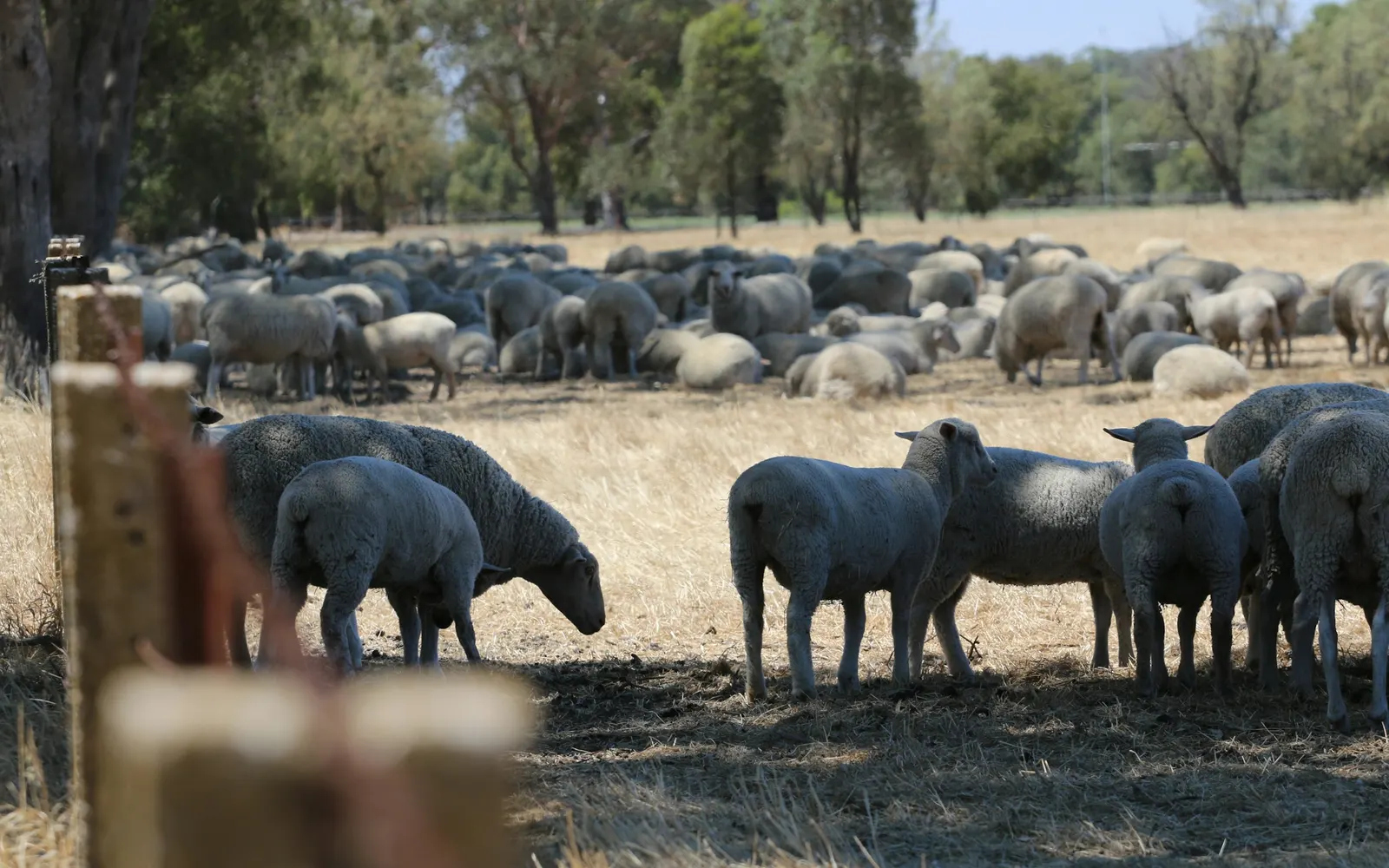
On a farm, sheep are counted as they run through a gateway or along a race, and stock agents count them "by the pair as they run past" or "five at a time" (Stringleman 2009). Counting in small groups works because people can see fewer than 4 items at a glance quickly and accurately, while counting bigger groups one by one is slow and error-prone (Trick and Pylyshyn 1994). And for sleep, a 2002 study of people with insomnia tested picturing an interesting, engaging scene, not counting sheep, and found it helped them fall asleep sooner than no instructions (Harvey and Payne 2002).
How do farmers count sheep?
At sales, sheep are counted on the move. Counting is "an important job for a stock agent, because farmers are paid per head of sheep sold", and with thousands of sheep sold in a day it has to be done quickly. "The sheep are counted as they run through a gateway or along a race" (Stringleman 2009). A race is a narrow lane that sheep walk along in single file or close to it.
Yards make this possible. New Zealand yards move sheep from a holding yard, through a forcing yard, into a drafting race "the width of two or three sheep" that "narrows in the last three metres to the width of one sheep" (Peden 2009a). Sheep "will move well if they can follow one another, and especially around a slight curve", and they prefer to move uphill and away from the sun (Peden 2009c). An even flow matters: Ontario's agriculture ministry says accurate drafting "requires an even flow of sheep" (O'Brien and Wand 2014).
Why count sheep in twos or fives?
Because people are far better at small numbers. Psychologists call the instant, no-counting recognition of a small group "subitizing". It works for "fewer than 4 items" and is "rapid (40-100 ms/item), effortless, and accurate". Counting more than 4 is "slow (250-350 ms/item), effortful, and error-prone" (Trick and Pylyshyn 1994). That was tested with dots on a screen, not sheep, but it explains the stock agent's habit.
When two sheep pass together you can see "two" without counting, and add 2. Some agents count five at a time (Stringleman 2009). Five is past the "fewer than 4" limit in the lab results above, so a five is more than a single glance.
How do you keep a tally?
A tally is the running total you keep while counting. The woolshed has its own system. "Once a sheep has been shorn, it is released into a counting pen. This allows an exact tally to be kept of each shearer's work" (Peden 2009b).
At a sale or a port, the count is checked several times. Australian live export sheep have been "manually counted several times, not only at the ports of embarkation and disembarkation but also at feeding lots", with port counts done by tally clerks (Kassler 2001). Sheep were loaded at Fremantle at rates "as high as 9,000 sheep per hour = 150 sheep per minute" (Kassler 2001). Speed was one of three tests the report set for any counting machine, alongside accuracy and cost.
There are also accepted margins for error in some systems. In New Zealand, when a meat processor checks an animal status declaration in MyOSPRI, sheep tallies can differ by "3% on either side", while "Cattle tallies must match exactly" (OSPRI n.d.). Our guide to how to count cattle covers gate and race counts for cattle.
| Situation | How the count is made | Source |
|---|---|---|
| Stock sale (New Zealand) | Through a gateway or race, by the pair or five at a time; three or four counts per sale | Stringleman 2009 |
| Shearing | Each shearer's sheep go into a counting-out pen for an exact tally | Peden 2009b |
| Drafting in the yards | Sheep run single file down the race and gates split them into pens | Peden 2009a; Egan n.d. |
| Electronic tag reading | A reader counts and records tagged sheep whenever they are handled | Agriculture Victoria 2020 |
| Live export (Australia) | Counted by hand several times at feedlots and ports; tally clerks count at the ports | Kassler 2001 |
How do you count sheep by draft?
Drafting means sorting sheep into groups, for example ewes from lambs. In a typical New Zealand yard, two drafting gates at the end of the race "divide the mob three ways", and an extra gate lets some yards divide sheep "five ways" (Peden 2009a). A sheep handling guide from Ireland's Teagasc says sheep should be "in single file in the race for sorting", that "3-way sorting is enough for a 1-person unit", and that sorting 4 ways takes 3 gates and 2 people (Egan n.d.).
Ontario's agriculture ministry recommends a sorting race at least 3 m long with solid sides, so sheep are not distracted by those on the other side, and a draft gate at least 1 m long so sheep can leave the race easily (O'Brien and Wand 2014). That is roughly 9.8 feet and 3.3 feet (our arithmetic, using conversion factors from National Institute of Standards and Technology n.d.).
Can electronic tags count sheep for you?
Partly. Agriculture Victoria says the most basic electronic identification (EID) systems using electronic NLIS (Sheep) tags "can help you by counting and recording stock whenever they are handled", answering questions such as "Exactly how many sheep are on your property right now?" (Agriculture Victoria 2020).
Panel readers, fixed beside a race, "are particularly useful when you have large numbers of stock". They read in every direction, with a range of "between 55cm and 150cm", so they must be set up to read only the sheep you want. Most "don't come with any means of number storage", so they are linked to a scale indicator, computer or handheld device that keeps the tag numbers (Agriculture Victoria 2025). Our guide to sheep ear tag colours and eID covers the tags.
Why do sheep counts go wrong?
Sheep look alike and travel in a tight bunch. A Meat & Livestock Australia report on automatic counting pointed to "the lack of 100% accuracy inherent in human counting of large numbers of animals that superficially look alike". It estimated that about ".3% of the sheep exported" were not counted at the destination, around 15,000 sheep a year (Kassler 2001).
Machines struggle for the same reason. People-counting cameras rely on the gap between heads, but in a crowd of sheep "adjacent sheep touch each other" and "one sheep may be partly on top of or under another sheep" (Kassler 2001). The report concluded only systems promising accuracy above 99% were worth developing, and proposed separating sheep one at a time onto a counting ramp; that was a proposal to be tested, not a finished machine (Kassler 2001).
Count My Herd, our phone app, counts sheep in a few paddock photos and gives a range around the count. In our first check, 9 small groups of animals (1 to 7 head, one photo each) were all counted exactly; big mobs and sweeps of several photos have not been tested yet, so it is an estimate, not a count through the race. For the bigger picture, see how many sheep there are in Australia.
Does counting sheep help you sleep?
The research we found does not test it directly. A related study is by Allison Harvey and Suzanna Payne at the University of Oxford, published in Behaviour Research and Therapy in 2002. Forty-one people with insomnia were given one of three sets of instructions for the night: distract yourself with imagery, distract yourself in general, or no instructions. The researchers predicted that "imagery distraction" would shorten the time to fall asleep compared with no instructions, and that general distraction would lengthen it. "Support was found for the first but not the second prediction" (Harvey and Payne 2002).
The authors put the imagery task's success down to it taking up enough "cognitive space" to stop people going back to their worries (Harvey and Payne 2002). The study's summary does not mention sheep at all. So the honest answer is that picturing an interesting, engaging scene helped in this study, and this study did not test counting sheep. If sleep problems persist, a doctor is the right person to ask.
Common questions
How do farmers count sheep?
Sheep are counted as they run through a gateway or along a race, so they pass in a line rather than as a crowd. At New Zealand sales, some stock agents count them by the pair and others count five at a time, and sheep may be counted three or four times between arriving at a sale and being trucked out.
Why do people count sheep in twos?
People can recognise fewer than 4 items at a glance quickly and accurately, which psychologists call subitizing. Counting more than 4 items one by one is slower, at 250 to 350 milliseconds per item in lab tests, and error-prone. Counting sheep in pairs as they run past keeps each step inside that easy range.
How do you count sheep correctly?
Get them moving in a line, through a gateway, a race or a drafting gate, and count them as they pass. Even flow helps: accurate drafting needs an even flow of sheep. Count more than once, as stock agents do at sales, and where sheep carry electronic NLIS tags, a reader can count and record them whenever they are handled.
Does counting sheep help you fall asleep?
We found no study that tests it directly. Harvey and Payne (2002) gave 41 people with insomnia one of three sets of instructions. Imagining an interesting, engaging scene was linked to falling asleep sooner than having no instructions, while general distraction did not show the predicted effect. The study summary does not mention sheep.
Can a machine count sheep?
Electronic NLIS (Sheep) tags let a reader count and record sheep as they are handled. Cameras find it harder, because sheep in a crowd touch and can be partly on top of each other. A 2001 Meat and Livestock Australia report said only systems promising accuracy above 99% were worth developing for live export counting.
References
- Agriculture Victoria (2020) 'Benefits of EID', On-farm benefits of electronic identification (EID), Agriculture Victoria. Available at: https://agriculture.vic.gov.au/livestock-and-animals/sheep/onfarm-benefits-of-electronic-identification-EID/benefits-of-eid (Accessed: 17 October 2026).
- Agriculture Victoria (2025) 'Choosing an EID tag reader and software', Agriculture Victoria. Available at: https://agriculture.vic.gov.au/livestock-and-animals/sheep/onfarm-benefits-of-electronic-identification-EID/choosing-an-eid-tag-reader-and-software (Accessed: 17 October 2026).
- Egan, E. (n.d.) A guide to designing a sheep handling unit, Teagasc. Available at: https://teagasc.ie/wp-content/uploads/2025/05/A-Guide-to-Designing-a-Sheep-Handling-Unit.pdf (Accessed: 17 October 2026).
- Harvey, A.G. and Payne, S. (2002) 'The management of unwanted pre-sleep thoughts in insomnia: distraction with imagery versus general distraction', Behaviour Research and Therapy, 40(3), pp. 267 to 277. Available at: https://doi.org/10.1016/S0005-7967(01)00012-2 (Accessed: 17 October 2026).
- Kassler, M. (2001) Automatic counting of sheep, Final report LIVE.106, Meat & Livestock Australia and LiveCorp. Available at: https://www.mla.com.au/contentassets/4312471af05f4f2ebd74484c901dd5df/live.106_final_report.pdf (Accessed: 17 October 2026).
- National Institute of Standards and Technology (n.d.) 'NIST Guide to the SI, Appendix B.9: Factors for units listed by kind of quantity or field of science', NIST. Available at: https://www.nist.gov/pml/special-publication-811/nist-guide-si-appendix-b-conversion-factors/nist-guide-si-appendix-b9 (Accessed: 17 October 2026).
- O'Brien, A. and Wand, C. (2014) Use sheep behaviour to your advantage when designing handling facilities, Factsheet 14-035, Ontario Ministry of Agriculture, Food and Rural Affairs. Available at: https://files.ontario.ca/omafra-use-sheep-behaviour-to-your-advantage-when-desgining-handling-facilities-14-035-en-2022-12-08.pdf (Accessed: 17 October 2026).
- OSPRI (n.d.) 'How to find and complete a meat processing animal status declaration (ASD) in MyOSPRI', OSPRI New Zealand. Available at: https://ospri.co.nz/farming-industry-providers/myospri-user-guides-for-farming-industry-providers/how-to-find-and-complete-a-meat-processing-animal-status-declaration-asd-in-myospri (Accessed: 17 October 2026).
- Peden, R. (2009a) 'Farm fencing: Yards', Te Ara, the Encyclopedia of New Zealand. Available at: https://teara.govt.nz/en/farm-fencing/page-6 (Accessed: 17 October 2026).
- Peden, R. (2009b) 'Farm buildings: Woolsheds' (image: Counting-out pens), Te Ara, the Encyclopedia of New Zealand. Available at: https://teara.govt.nz/en/photograph/18536/counting-out-pens (Accessed: 17 October 2026).
- Peden, R. (2009c) 'Farm fencing: Yards' (image: The drafting race), Te Ara, the Encyclopedia of New Zealand. Available at: https://teara.govt.nz/en/photograph/17481/the-drafting-race (Accessed: 17 October 2026).
- Stringleman, H. (2009) 'Stock and station agencies: Role in the community' (image: Counting sheep), Te Ara, the Encyclopedia of New Zealand. Available at: https://teara.govt.nz/mi/photograph/17397/counting-sheep (Accessed: 17 October 2026).
- Trick, L.M. and Pylyshyn, Z.W. (1994) 'Why are small and large numbers enumerated differently? A limited-capacity preattentive stage in vision', Psychological Review, 101(1), pp. 80 to 102. Available at: https://doi.org/10.1037/0033-295X.101.1.80 (Accessed: 17 October 2026).