
How to tell sheep from goats: tails, coats, diet, behaviour and chromosomes
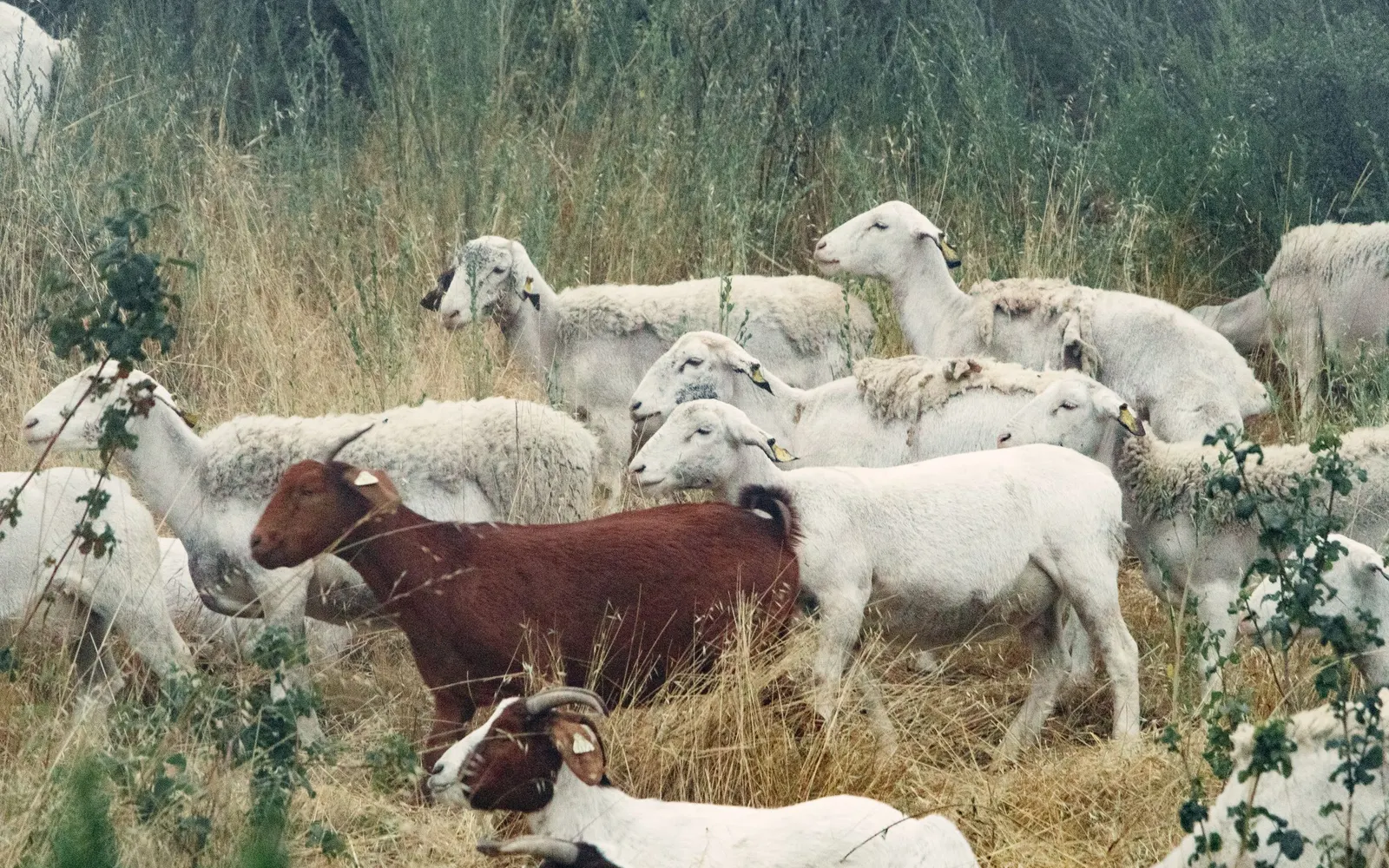
The quickest way to tell a sheep from a goat is the tail: a sheep's tail hangs down, while a goat's tail points straight up (Rios de Alvarez n.d.). Then check the coat and diet: sheep mostly grow wool and graze grass, while all goats grow hair and lean towards browsing leaves and shrubs (UGA Extension 2023). Underneath, they are separate species with different chromosome numbers: 54 for sheep and 60 for goats (Pauciullo et al. 2016).
How do you tell sheep and goats apart at a glance?
Sheep and goats are both called small ruminants, a name that comes from the anatomy of their digestive tract (UGA Extension 2023). A Mississippi State University Extension sheep and goat specialist sums up the main differences in one table (Rios de Alvarez n.d.):
| Feature | Sheep | Goats |
|---|---|---|
| Species | Ovis aries | Capra hircus |
| Number of chromosomes | 54 | 60 |
| Tail length | Short or long | Short |
| Direction of tail | Hanging | Straight up |
| Gland between toes | Yes | No |
| Gland beneath tail | No | Yes |
| Tear gland | Yes | No |
| Beard | No | Yes |
| Fleece | Wool or hair | Hair or fibre |
| Feeding behaviour | Grazers | Browsers |
| Plant preferences | Grasses and low-lying vegetation | Leaves, fruits and high-growing woody plants, shrubs and shoots |
You will not see the glands from the fence, so for a quick check in the paddock, start with the tail, then the coat, then the beard.
Do sheep tails go up or down?
Down. The extension table lists a sheep's tail as "hanging" and a goat's tail as "straight up" (Rios de Alvarez n.d.). Sheep tails can be short or long, while goat tails are short.
Tail length on its own can mislead you, because the table lists sheep tails as either short or long. Look at which way the tail points, not how long it is.
Wool or hair: does the coat tell you?
Usually, but not always. University of Georgia Extension notes that "sheep most often produce wool, though we do have breeds of sheep that produce hair instead", and that "all goats produce hair" (UGA Extension 2023). Mississippi State lists the sheep fleece as wool or hair and the goat coat as hair or fibre (Rios de Alvarez n.d.). Fibre is one of the main products listed for goats (Rios de Alvarez n.d.), so not every goat has a short, sleek coat.
So a woolly animal is very likely a sheep, but a hairy one could be either a goat or a hair sheep. When the coat leaves you unsure, go back to the tail.
What about beards?
The Mississippi State table lists a beard as present in goats and absent in sheep (Rios de Alvarez n.d.). A beard is a useful extra clue alongside the tail and coat.
Is it true goats do not have a split upper lip?
This is a common tip, but the anatomy sources do not back it up. A veterinary anatomy lecture from the University of Diyala says the upper lip in "small ruminant (sheep and goat)" has a "median groove or furrow called philtrum" (Ibrahim 2019). A 2024 study of goat lips from the Jammu region of India found that the goat "upper lip was divided by a vertical median philtrum" (Sethi et al. 2024).
Both species have the groove, so we would not rely on the lip to tell them apart. The tail and coat are better field signs.
Can you tell sheep from goats by their horns?
Not on their own. Both species can have horns or be hornless (polled), depending on breed and genetics.
In wild Soay sheep, horn type is inherited through a single gene. Most males have large normal horns, a few have small deformed horns called scurs, and females have normal horns, scurs or none at all (Johnston et al. 2011). In goats, being polled is linked to a condition called polled intersex syndrome: the lack of horns is dominant in both sexes, and the same mutation causes sex reversal in XX (genetically female) goats that inherit two copies of it (Pailhoux et al. 2001).
The upshot: horns tell you something about the breed and the individual, but a horned animal can be a sheep or a goat, and so can a hornless one.
Do sheep and goats eat different things?
Yes, by preference. Sheep are grazers, mainly eating grasses and low-lying plants, while goats are browsers that prefer leaves, fruits, woody plants, shrubs and shoots (Rios de Alvarez n.d.). University of Georgia Extension puts it the same way: sheep are grazers interested in eating grasses, while goats "tend to prefer roughage like twigs, leaves, or other vegetation" (UGA Extension 2023).
| Animal | Grasses | Legumes | Browse |
|---|---|---|---|
| Sheep | 45 to 55 | 30 to 40 | 10 to 20 |
| Goats | 20 to 30 | 10 to 30 | 30 to 50 |
The split is not fixed, though. In a study of shepherded sheep and goats in Israel's Negev Desert, both species only grazed while herbaceous plants (non-woody plants) were plentiful. The difference showed up as that feed dried off: goats then browsed more and ate a higher share of browse than sheep. In one late-season week, browse made up 0.85 of the goats' dry matter intake and 0.62 of the sheep's (Kam, El-Meccawi and Degen 2012).
The authors say results like these could help in managing mixed flocks of sheep and goats (Kam, El-Meccawi and Degen 2012). For stocking numbers, see how many goats per acre and how many sheep per acre.
Do sheep and goats behave differently?
Yes. University of Georgia Extension says sheep "have very strong flocking instincts, meaning they tend to be more cautious, more reactive as individuals, and easier to handle as a large group." Goats "tend to be more independent and inquisitive. They still like being in a herd, but they are not as driven by herding behavior as sheep are." The same source warns that keeping them contained is a challenge, adding that "goats LOVE to escape" (UGA Extension 2023).
How many chromosomes do sheep and goats have?
Domestic sheep (Ovis aries) have 54 chromosomes and domestic goats (Capra hircus) have 60. Chromosomes are the bundles of DNA that carry an animal's genes, and the two species differ "in both the number and morphology of their chromosomes", meaning the number and the shape (Pauciullo et al. 2016).
Can sheep and goats breed?
Very rarely, and almost never successfully. Sheep and goats "do not readily interbreed", and hybrid pregnancies "are normally lost by 6 to 8 weeks of gestation", mainly through placental failure and the mismatch in chromosomes (Pauciullo et al. 2016).
The same paper describes a healthy female hybrid born in March 2014 in a small flock near Göttingen, Germany, from a ewe and a buck (male goat). She had 57 chromosomes, between the two parents. The authors believed she was "the first and only living and healthy hybrid after natural mating of a ewe with a buck", because earlier reported live hybrids came from goats mated with rams (Pauciullo et al. 2016).
Why it matters on the farm
Getting the species right matters for more than curiosity. In Australia, sheep and managed goats must carry a species-specific NLIS approved electronic tag before leaving a property from 1 January 2027, so a goat needs a goat device and a sheep a sheep device (Integrity Systems Company n.d.). Our guide to sheep and goat ear tag colours explains the year of birth colours and eID dates.
Common questions
What is the easiest way to tell a sheep from a goat?
Look at the tail. A Mississippi State University Extension table lists a sheep's tail as hanging and a goat's tail as straight up. Then check the coat and beard: most sheep grow wool, all goats grow hair, and the same table lists a beard for goats but not for sheep.
Do goats have a split upper lip like sheep?
Yes. Although many guides say only sheep have a groove in the upper lip, a veterinary anatomy lecture describes a groove called the philtrum in both sheep and goats, and a 2024 study of goat lips found the upper lip divided by a vertical median philtrum. The lip is not a reliable test.
How many chromosomes do sheep and goats have?
Domestic sheep have 54 chromosomes and domestic goats have 60, according to a 2016 study in Scientific Reports. The two species differ in both the number and the shape of their chromosomes, which is one reason they do not readily interbreed.
Can sheep and goats breed together?
Very rarely. Sheep and goat hybrid pregnancies are normally lost by 6 to 8 weeks of gestation. A healthy female hybrid born in Germany in 2014 to a ewe and a buck had 57 chromosomes, and researchers described it as the first living, healthy hybrid known from that cross after natural mating.
Do goats eat grass like sheep?
They can, but they prefer browse. Sheep are grazers of grasses and low plants, while goats prefer leaves, shrubs and woody plants. In a Negev Desert study both grazed while soft plants were plentiful, and goats browsed more than sheep once that feed became scarce.
References
- Ibrahim, K. (2019) 'Anatomy of digestive system (2)', lecture notes, Department of Anatomy and Histology, College of Veterinary Medicine, University of Diyala. Available at: https://vetmed.uodiyala.edu.iq/uploads/2019/dr%20khaled%D8%AA%D8%B4%D8%B1%D9%8A%D8%AD/digestive%202.pdf (Accessed: 17 October 2026).
- Integrity Systems Company (n.d.) 'Animal Identification', Integrity Systems. Available at: https://www.integritysystems.com.au/identification--traceability/animal-identification/ (Accessed: 17 October 2026).
- Johnston, S.E., McEwan, J.C., Pickering, N.K., Kijas, J.W., Beraldi, D., Pilkington, J.G., Pemberton, J.M. and Slate, J. (2011) 'Genome-wide association mapping identifies the genetic basis of discrete and quantitative variation in sexual weaponry in a wild sheep population', Molecular Ecology, 20(12), pp. 2555 to 2566. Available at: https://doi.org/10.1111/j.1365-294X.2011.05076.x (Accessed: 17 October 2026).
- Kam, M., El-Meccawi, S. and Degen, A.A. (2012) 'Foraging behaviour and diet selection of free-ranging sheep and goats in the Negev Desert, Israel', The Journal of Agricultural Science, 150, pp. 379 to 387. Available at: https://doi.org/10.1017/S0021859611000955 (Accessed: 17 October 2026).
- Pailhoux, E., Vigier, B., Chaffaux, S., Servel, N., Taourit, S., Furet, J.P., Fellous, M., Grosclaude, F., Cribiu, E.P., Cotinot, C. and Vaiman, D. (2001) 'A 11.7-kb deletion triggers intersexuality and polledness in goats', Nature Genetics, 29(4), pp. 453 to 458. Available at: https://doi.org/10.1038/ng769 (Accessed: 17 October 2026).
- Pauciullo, A., Knorr, C., Perucatti, A., Iannuzzi, A., Iannuzzi, L. and Erhardt, G. (2016) 'Characterization of a very rare case of living ewe-buck hybrid using classical and molecular cytogenetics', Scientific Reports, 6, 34781. Available at: https://doi.org/10.1038/srep34781 (Accessed: 17 October 2026).
- Rios de Alvarez, L. (n.d.) 'Sheep and goats basics', presentation, Mississippi State University Extension. Available at: https://extension.msstate.edu/media/30218/download (Accessed: 17 October 2026).
- Sethi, L., Sarma, K., Suri, S., Devi, J. and Sasan, J.S. (2024) 'Gross anatomical studies on the lips of non-descript goats of Jammu region: an age related study', Indian Journal of Veterinary Anatomy, 36(2). Available at: https://epubs.icar.org.in/index.php/IJVA/article/view/170941 (Accessed: 17 October 2026).
- UGA Extension (2023) 'Small ruminants: sheep and goats', University of Georgia Cooperative Extension, Lincoln County. Available at: https://site.extension.uga.edu/lincoln/small-ruminants-sheep-and-goats/ (Accessed: 17 October 2026).
- Wallau, M. (2019) 'Pasture systems for sheep and goats', in 2019 Small Ruminant Workshop Proceedings, UF/IFAS Extension, Gainesville, 21 September 2019. Available at: https://extadmin.ifas.ufl.edu/media/extadminifasufledu/nflag/pdfs/2019-Small-Ruminant-Workshop-Proceedings.pdf (Accessed: 17 October 2026).