
How to count horses without losing track
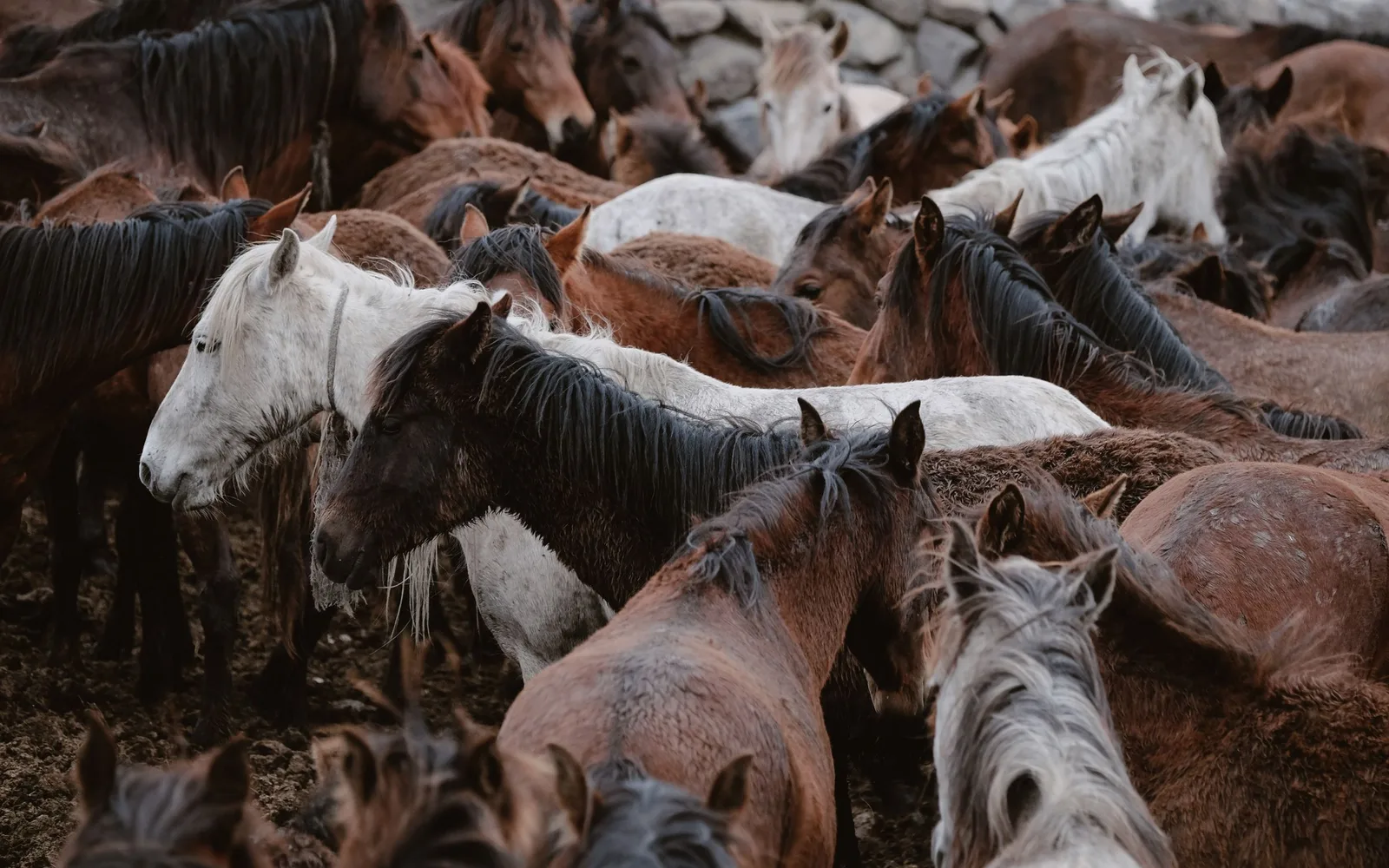
Horses in a paddock are hard to count by eye because they bunch together, overlap and keep moving while you are still working out a number. Even professional aerial surveys of feral horses, using trained observers and statistical correction, produced counts that were between 8.5% too low and 13.7% too high against a known population (Lubow and Ransom 2016). The fix is the same whether you are checking a small paddock or a wild herd: get the horses lined up or standing still, count in small batches, and check your number more than once.
Why is it hard to count horses in a paddock?
Horses are herd animals. Left alone in a paddock they tend to stand close together, especially in bad weather or when something disturbs them, so one horse's body hides another's legs, head or whole outline from certain angles. Add in a horse walking behind a tree, over a rise, or simply turning around while you are counting, and the same animal can easily be missed, or counted twice if it moves to where you have already looked.
This is not just a backyard problem. Even wildlife researchers who count feral horses professionally from aircraft, with trained observers and purpose built statistical models, found that uncorrected aerial counts can miss "up to one third or more" of the animals present, mostly because of how well each horse can be seen on the day (Lubow and Ransom 2016). If professionals miss that many animals from the air, a quick glance across a paddock from the fence line is going to be even less reliable.
How many horses can you count at a glance?
Psychology research on how people take in numbers of objects found a sharp line at around 4 items. Below that, people recognise how many things they are looking at almost instantly: "fewer than 4 items" is "rapid (40 to 100 ms/item), effortless, and accurate." Above 4, the brain switches to a slower, deliberate process: "the process of enumeration when there are more than 4 items, is slow (250 to 350 ms/item), effortful, and error-prone" (Trick and Pylyshyn 1994). That study was done with dots on a screen in a laboratory, not horses in a paddock, but it explains why glancing at a mob of 15 horses and expecting an instant, correct number is unrealistic. The practical answer is to break the group down: count 3 or 4 horses at a time as separate small groups, rather than trying to take in the whole mob in one look.
How do you count horses that are moving or bunched together?
Movement is the single biggest cause of miscounts, in horses as in other animals. The clearest documented example comes from aerial surveys of feral horses in the western United States. When a helicopter approached, "nearly every horse group was disturbed by the approaching helicopter and responded by running long before the helicopter reached it", which made it hard for observers to keep track of which group was which. Some horse groups then escaped notice entirely because they ran into ground that had already been checked, while other running groups were spotted more easily than they should have been because the movement and dust they kicked up made them stand out, with researchers noting "it is possible that some groups were mistakenly seen and counted twice" (Lubow and Ransom 2016). The researchers concluded that airplanes are preferable to helicopters whenever the terrain does not require a helicopter, because helicopters cause a behavioural reaction in the animals that is hard to correct for statistically (Lubow and Ransom 2016).
The same researchers found that group size itself changes how reliably a horse group is spotted. Their statistical model needed to account for "animal behavior, group size, and distance from observer" as well as weather and ground cover, because larger, tighter bunches of horses behave differently to counts than horses spread out and standing still (Lubow and Ransom 2016). For a paddock check, the lesson carries over directly: a horse herd standing still and spread out is far easier to count correctly than the same herd milling about or packed into a corner.
What a long running head count can teach you
New Zealand's Kaimanawa wild horses offer a real example of how counting method, not just population growth, can change the numbers over the years. There were 174 horses recorded in the southern Kaimanawa area in 1979, and official monitoring began in 1981. By April 1997 the count had risen to about 1,700 (Meyer 2009). A detailed demographic study of the same herd, based on measuring 413 feral horses directly, modelled how fast the population should have grown from births and deaths, and compared that model with the long run of aerial counts. The study concluded "the historical sequence of counts since 1979 has overestimated growth by ~50% probably because of improvements in count effort and technique" (Linklater et al. 2004). In plain terms, the counts made the herd look as if it was growing about 50% faster than it really was, probably because counting effort and technique improved over the years (Linklater et al. 2004). That large herd was eventually brought in: "in August 1997 the herd was mustered and many were sold at auction" (Meyer 2009).
How do you muster or yard horses to count them?
Getting horses into a yard, or at least bunched and settled in one place, turns a hard visual estimate into something closer to a real count. Wild horse management agencies in the United States use two main mustering methods, helicopter gathers and bait trapping, and researchers studying horse welfare during these musters recorded details including "number of horses mustered and shipped daily" as part of their data (Scasta, Hennig and Calkins 2021). That daily tally only works because the horses are concentrated in yards during a muster, rather than scattered over open range.
On a working property, the same principle applies at a smaller scale: a horse owner checking numbers is better placed if the horses are caught up or yarded rather than spread across a large paddock. Agriculture Victoria's guidance for anyone keeping a horse includes checking "is your property appropriately fenced and suitable for catching and working the horse" before buying one, alongside being able to "visit your horse daily" (Agriculture Victoria 2026). Fencing and yards that make catching possible are also what make an accurate head count possible, for the same reason a race or crowding pen helps with cattle, covered in our guide to how to count cattle.
| Situation | What helps | What goes wrong |
|---|---|---|
| Small group at a glance | Groups of fewer than 4 are recognised almost instantly (Trick and Pylyshyn 1994) | Above 4, counting is slow and error-prone (Trick and Pylyshyn 1994) |
| Horses bunched or milling | Letting them settle and spread out before counting | Bodies overlap, hiding animals from some angles (Lubow and Ransom 2016) |
| Horses moving or spooked | Counting once they have stopped, not mid run | Same horse may be missed or seen twice if it moves between looks (Lubow and Ransom 2016) |
| Aerial survey of a herd | Plane rather than helicopter where terrain allows; statistical correction | Even corrected estimates ranged from 8.5% low to 13.7% high against a known count (Lubow and Ransom 2016) |
| Yarded or mustered | Horses concentrated in one place for an actual tally (Scasta, Hennig and Calkins 2021) | Not covered by our sources |
Can drone or photo counting help with horses?
Photo based counting shows promise for animals in general, though the published research we found tested it on other species rather than horses specifically. In a controlled trial using life sized replica seabird colonies with a known number of fake birds, counts taken from drone photos were "on average, between 43% and 96% more accurate than the traditional ground-based data collection method," and the researchers showed that counting from that imagery "can be semi-automated with a high degree of accuracy" (Hodgson et al. 2018). The advantage of a photo is the same one that helps with horses: it freezes a moving, overlapping group into a single instant, so you can count it calmly rather than trying to track animals that keep shifting position in front of you.
Count My Herd, our phone app, applies this idea to paddock photos of cattle, sheep, horses or goats. It puts a dot on every animal it finds in the photo and gives a range around the count. It is early days for the app. In our first check, 9 small groups of animals (1 to 7 head, one photo each) were all counted exactly. Big mobs and sweeps of several photos have not been tested yet. Treat any photo count, from an app or otherwise, as an estimate rather than a tally through a yard. For more on how paddock counting compares with other livestock, see our guides to how many horses per acre for stocking numbers, and mustering cattle for how a muster is run on a cattle property.
How do you double check a horse count?
Count more than once, and count under calmer conditions where possible. The aerial survey research found that disturbance, mostly from a helicopter's approach, was the main cause of both missed horses and double counted horses on the same flight (Lubow and Ransom 2016). The same applies at paddock scale: a head count taken while horses are settled, ideally caught up, yarded or at least not spooked, will be more reliable than one taken while they are moving. Where you have a long running record, like the Kaimanawa herd's count history, it is also worth remembering that a change in the number from one year to the next might reflect a change in method rather than a change in the herd (Linklater et al. 2004).
Common questions
Why is it hard to count horses in a paddock?
Horses bunch together as herd animals, so one horse's body can hide another from view, and the group keeps moving while you count. Even professional aerial surveys of feral horses, done by trained observers with statistical correction, produced counts between 8.5% too low and 13.7% too high against a known population.
How many horses can a person count accurately at a glance?
Research on how people take in numbers of objects found a sharp line around 4 items. Groups of fewer than 4 are recognised almost instantly and accurately. Above 4, counting becomes a slower, deliberate process at 250 to 350 milliseconds per item, and is more prone to error.
Does movement cause horses to be miscounted?
Yes. In aerial surveys, a helicopter's approach disturbed nearly every horse group, causing them to run before the aircraft arrived. Some groups then escaped notice by running into already checked ground, while others were spotted more easily because of their movement and dust, and researchers said it is possible some groups were counted twice.
How do you muster or yard horses to get an accurate count?
Bringing horses into a yard or holding area, by helicopter gather or bait trapping, concentrates them in one place so they can be tallied as they are handled, rather than estimated by eye across open country. On a smaller property, having yards and fencing suitable for catching and working a horse makes a reliable head count possible.
Can a photo or app count horses accurately?
Photo based counting can help because it freezes a moving group into a single instant. In a trial on replica wildlife colonies, drone photo counts were on average 43% to 96% more accurate than ground counts. Treat any photo count as an estimate, not a yard tally.
References
- Agriculture Victoria (2026) 'Basic horse care', Agriculture Victoria, archived snapshot. Available at: https://web.archive.org/web/20260415102813/https://agriculture.vic.gov.au/livestock-and-animals/horses/basic-horse-care (Accessed: 6 November 2026).
- Hodgson, J.C., Mott, R., Baylis, S.M., Pham, T.T., Wotherspoon, S., Kilpatrick, A.D., Raja Segaran, R., Reid, I., Terauds, A. and Koh, L.P. (2018) 'Drones count wildlife more accurately and precisely than humans', Methods in Ecology and Evolution, 9(5), pp. 1160 to 1167. Available at: https://doi.org/10.1111/2041-210X.12974 (Accessed: 6 November 2026).
- Linklater, W.L., Cameron, E.Z., Minot, E.O. and Stafford, K.J. (2004) 'Feral horse demography and population growth in the Kaimanawa Ranges, New Zealand', Wildlife Research, 31(2), pp. 119 to 128. Available at: https://doi.org/10.1071/WR02067 (Accessed: 6 November 2026).
- Lubow, B.C. and Ransom, J.I. (2016) 'Practical Bias Correction in Aerial Surveys of Large Mammals: Validation of Hybrid Double-Observer with Sightability Method against Known Abundance of Feral Horse (Equus caballus) Populations', PLoS ONE, 11(5), e0154902. Available at: https://doi.org/10.1371/journal.pone.0154902 (Accessed: 6 November 2026).
- Meyer, E. (2009) 'Horses: Horses and the environment', Te Ara, the Encyclopedia of New Zealand. Available at: https://teara.govt.nz/en/horses/page-7 (Accessed: 6 November 2026).
- Scasta, J.D., Hennig, J.D. and Calkins, C.M. (2021) 'Feral horse cause-specific mortality relative to mustering (gathering) and individual demographic attributes in the USA', Wildlife Research, 48(8), pp. 673 to 689. Available at: https://doi.org/10.1071/WR20157 (Accessed: 6 November 2026).
- Trick, L.M. and Pylyshyn, Z.W. (1994) 'Why are small and large numbers enumerated differently? A limited-capacity preattentive stage in vision', Psychological Review, 101(1), pp. 80 to 102. Available at: https://doi.org/10.1037/0033-295X.101.1.80 (Accessed: 6 November 2026).